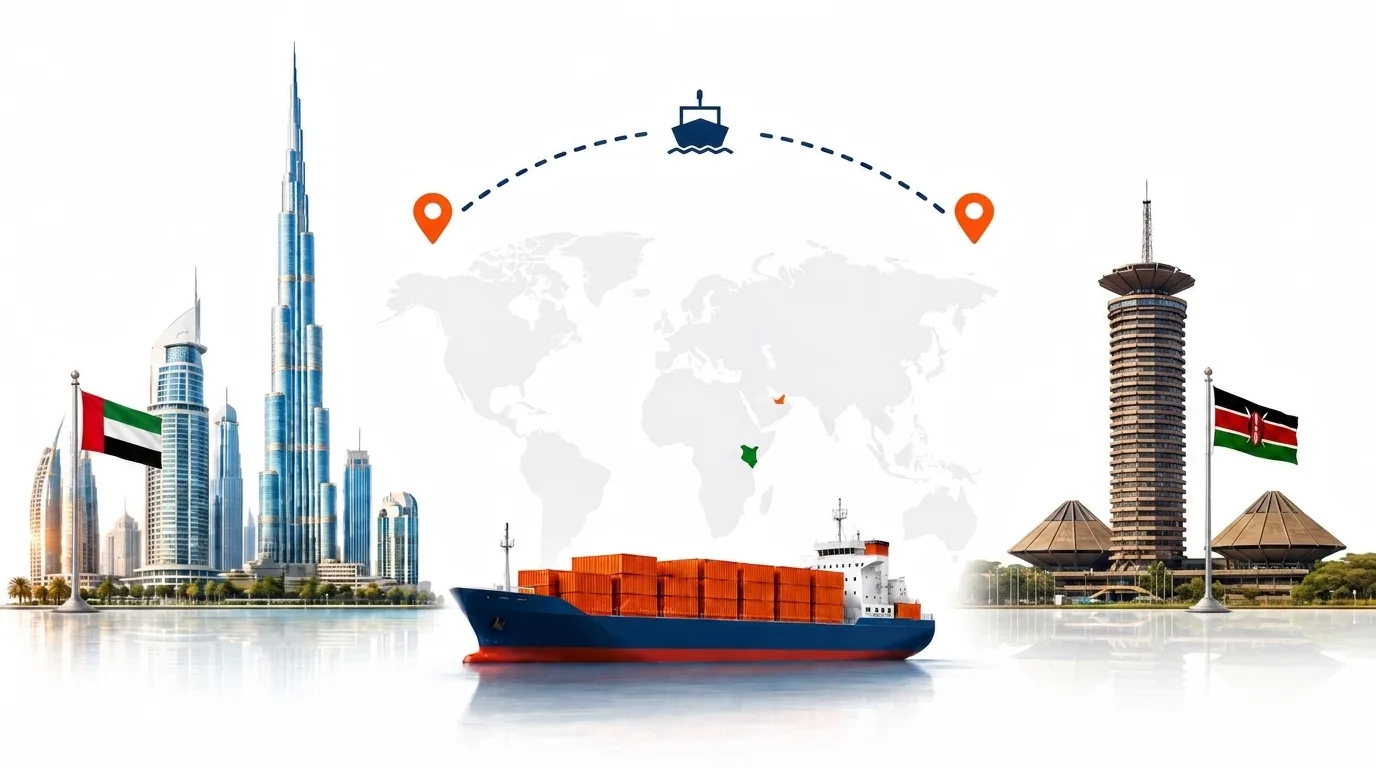
Shipping from Dubai to Kenya

1. Shipping from Dubai to Kenya by sea or air

Sea freight through Mombasa carries most cargo on this lane, but the method decision should come after you have established whether your goods fall under PVoC — because that determines your lead time far more than the sailing schedule does.

Air freight suits urgent, compact or higher-value consignments — machine spares, electronics, samples, time-sensitive stock. Nairobi is a significant regional air cargo hub, which gives this lane better air service depth than most African destinations. Pricing runs on chargeable weight, so bulky light cargo prices poorly.

LCL sea freight suits smaller commercial consignments — pallets, boxed stock, partial orders. Consolidation in Dubai and deconsolidation at a Mombasa CFS add handling at both ends.

FCL suits full loads, building materials, machinery and high volume. It is also the option that opens up rail: a full container can be railed from Mombasa to the Nairobi Inland Container Depot on the Standard Gauge Railway and cleared there rather than at the coast, which changes the inland economics for Nairobi-bound cargo.

Road freight does not apply between the UAE and Kenya.

What changes the choice: whether the commodity is PVoC-regulated and how long certification takes, packed volume against weight, the final city, and whether the consignee prefers to clear at Mombasa or at Nairobi ICD.

To be quoted properly, send: cargo description and HS code, package count, packed dimensions per piece, gross weight, ready date, final delivery city, and confirmation of PVoC status.

MethodSuitable cargoPrice basisMain consideration
Air freightUrgent, compact, higher-valueChargeable weight (divisor 6000)Nairobi is a strong regional air hub; good service depth
LCL sea freightPallets, boxed stock, partial ordersPer CBM or per 1,000 kg, whichever greaterConsolidation and CFS handling add days at both ends
FCL containerFull loads, building materials, machineryPer container by type and routeOpens the SGR rail option to Nairobi ICD
Road freightNot applicableNo overland route from the UAE

2. What cargo can you ship from Dubai to Kenya?

A wide range of commercial cargo moves from Dubai to Kenya, but a significant share of it falls under mandatory conformity assessment — so the first question on any commodity is not whether it can be shipped, but whether it needs a certificate first.

General merchandise and consumer goods. Move regularly by both LCL and FCL. Many categories fall under PVoC scope.

Building and construction materials. A substantial part of this lane. Steel, fittings, tiles, sanitaryware, cement products, electrical fittings and hardware. Most of this category is PVoC-regulated and standards-sensitive.

Machinery, equipment and spare parts. Reviewable with make, model, serial number, condition and technical documentation. Used machinery attracts additional scrutiny.

Electronics and electrical goods. Commonly PVoC-regulated. Certification requirements are specific and should be established early.

Plastics, packaging and raw materials. Move in volume; check standards applicability per product.

Food and agricultural products. Subject to health, sanitary and phytosanitary certification in addition to any conformity requirement.

Textiles and apparel. Both new and, under separate and stricter rules, used clothing — the used category has its own conditions and should be checked specifically.

Vehicles. Subject to the age limit, right-hand-drive requirement and pre-export inspection. See section 10.

Restricted and regulated goods. Pharmaceuticals, medical devices, telecom equipment, chemicals, cosmetics and used goods generally require review before booking.

For any cargo review, send: exact product description, HS code, manufacturer and brand, country of origin, intended end use, packed dimensions and weight, and whether a Certificate of Conformity has already been obtained or is still to be arranged.

3. Sea freight from Jebel Ali to Mombasa - Shipping from Dubai to Kenya

3. Sea freight from Jebel Ali to Mombasa

Sea cargo from Jebel Ali to Kenya arrives at the Port of Mombasa, and the more useful decision is not which port but where the container is cleared — at the coast, or inland at Nairobi after a rail movement.

Origin port: Jebel Ali Port, Dubai Destination port: Port of Mombasa (Kilindini Harbour); Lamu has limited container relevance

Mombasa is Kenya's principal maritime gateway, operated by Kenya Ports Authority, and it serves not only Kenya but the wider Northern Corridor reaching Uganda, Rwanda, South Sudan and eastern DRC. That regional role means the port handles substantially more volume than Kenya's own trade alone, which affects both service frequency and congestion.

FCL gives a dedicated container, a single seal and a cleaner clearance file, and is required to use the rail option. LCL shares space and requires consolidation in Dubai and deconsolidation at a Mombasa CFS.

The SGR rail option. Full containers can be moved from Mombasa to the Nairobi Inland Container Depot at Embakasi on the Standard Gauge Railway and cleared there. For Nairobi-bound cargo this is often the more practical structure: the container moves inland under customs control and the consignee clears close to the delivery point rather than at the coast. Where it applies, it removes the long Mombasa–Nairobi road haul, which is the single largest inland cost on this route. Confirm current rail availability, scheduling and cost against your booking, since it varies. Current details must be confirmed before booking.

Container and equipment choices: 20ft standard for dense cargo, 40ft standard and high-cube for volume, with open-top or flat rack for out-of-gauge machinery.

Port clearance is handled by the consignee or their appointed clearing agent through KRA's iCMS, with declarations lodged via the Kenya TradeNet single-window system. Port charges, clearance costs, inspection and storage sit outside the freight rate unless the quotation says otherwise.

Transport from port to final city. Road from Mombasa, or rail to Nairobi ICD followed by a short road leg. For destinations beyond Nairobi — Nakuru, Eldoret, Kisumu — the journey continues by road along the Northern Corridor.

Transit cargo. Where goods are destined for Uganda, Rwanda, South Sudan or eastern DRC rather than Kenya, the customs treatment differs entirely from a Kenyan import. Declare this at the outset, as it is a different procedure, not a variation of one.

For a sea-freight quote, send: commodity and HS code, total packed CBM, gross weight, piece count, FCL or LCL preference, ready date, final city, whether Nairobi ICD clearance is preferred, and whether the cargo is a Kenyan import or transit.

4. Air cargo from Dubai to Kenya

Air cargo from Dubai to Kenya runs principally to Jomo Kenyatta International Airport in Nairobi, which is one of the stronger air cargo gateways on the African continent and gives this lane better service depth than most comparable destinations.

Origin airports: DXB, DWC Destination airports: NBO (Nairobi), MBA (Mombasa), EDL (Eldoret)

Nairobi handles substantial cargo volumes in both directions and supports a developed handling and clearing infrastructure. Mombasa serves the coastal region. Eldoret is cargo-oriented but its traffic is primarily export-driven, so inbound service should be confirmed rather than assumed.

Air suits urgent, compact or higher-value consignments — production spares, electronics, samples, pharmaceutical and medical goods against a deadline.

Actual weight versus chargeable weight. Airlines charge on the higher of actual gross weight and volumetric weight, calculated as length × width × height in centimetres divided by 6000. Bulky, light cargo prices as though it were considerably heavier.

PVoC applies to air shipments too. This catches people out. Conformity requirements attach to the goods, not to the transport mode, so an urgent air consignment of regulated products still needs its Certificate of Conformity obtained before departure. Air freight does not provide a way around the certification lead time.

Airline cargo acceptance depends on commodity, packing, labelling and documentation. Batteries, aerosols, chemicals and magnetised goods require dangerous-goods review before booking.

Airport clearance is handled by the consignee or their clearing agent. Airport storage accrues quickly.

Delivery from the airport to the final address is a separate leg, priced by distance and vehicle type.

For an air-freight quote, send: piece count, packed dimensions per piece, gross weight, commodity description and HS code, PVoC status, and the destination city.

5. Cargo shipping rates from Dubai to Kenya

Freight is only part of the landed cost on this route. Kenya applies duty, VAT and additional levies on imports, and for regulated goods the conformity certificate carries its own cost — a quotation covering freight alone can understate the total substantially.

Air rate basis. Chargeable weight at a rate band stepping down with weight, plus security screening, airline surcharges and documentation.

LCL rate basis. Per cubic metre or per 1,000 kg, whichever is greater, plus consolidation at origin and CFS handling at destination.

FCL rate basis. Per container by equipment type and route, plus terminal handling at both ends.

Pickup and packing. Collection in Dubai or the wider UAE by location, access and volume. Export packing, crating and palletising quoted separately.

Origin handling. Export documentation, terminal handling at Jebel Ali, UAE export processing.

PVoC certification cost. Inspection and Certificate of Conformity fees, charged by the appointed agency and typically calculated against consignment value. This is an origin-side cost, incurred before shipment, and it belongs in your landed-cost calculation from the start. Current details must be confirmed before booking.

Destination handling. Terminal or CFS handling, delivery order fees, port charges.

Customs duty and VAT. Assessed in Kenya against the HS classification and customs value.

Additional levies. An Import Declaration Fee and a Railway Development Levy apply to imports in addition to duty and VAT. Both are set by legislation and have been revised in Finance Acts, so the applicable rates should be confirmed currently.

Inland transport. Rail to Nairobi ICD, or road from Mombasa. For Nairobi and beyond this is a significant component, and the rail option can materially change it.

Worked example

Cargo: 1 × 40ft FCL of building fittings and hardware Method: Sea FCL, Jebel Ali → Mombasa, rail to Nairobi ICD Assumptions: PVoC-regulated commodity; CoC obtained before shipment; consignee clears at Nairobi ICD

Cost structure to expect — the elements, not the amounts:

StageCost elementWho paysWhen incurred
OriginUAE pickup and export packingShipperBefore departure
OriginPVoC inspection and Certificate of ConformityShipperBefore departure — blocks shipment if missing
OriginExport documentation and terminal handling, Jebel AliShipperBefore departure
FreightOcean freight, 40ft containerPer IncotermAt booking
DestinationTerminal handling, MombasaPer IncotermOn arrival
DestinationSGR rail, Mombasa → Nairobi ICDPer IncotermAfter discharge
DestinationCustoms duty and VATImporterAt clearance
DestinationImport Declaration Fee and Railway Development LevyImporterAt clearance
DestinationClearing agent fees, ICD handling, any storageImporterAt clearance
DeliveryRoad from Nairobi ICD to final addressPer IncotermAfter release

The point of the table: on this lane the ocean freight line is frequently smaller than the combined duty, VAT and levy line, and the PVoC cost sits before the goods even move. Comparing two quotations on freight alone tells you very little.

Source/date: Current details must be confirmed before booking.

Important limitation: This shows the structure of the landed cost, not the amounts. Duty rates vary by HS code, levies are set by current legislation, and PVoC fees depend on the agency and consignment value.

6. Dubai to Kenya shipping times - Shipping from Dubai to Kenya

6. Dubai to Kenya shipping times

Sea transit from Jebel Ali to Mombasa is measured in weeks and air to Nairobi in days, but on this route the schedule that most often determines the delivery date is the PVoC certification lead time before the cargo ever ships.

MethodEstimated main transitExtra delivery stepsSource and date
Air freightRequest a current shipment estimateAirport clearance, storage release, road deliveryCurrent details must be confirmed before booking.
LCLRequest a current shipment estimateConsolidation cut-off, CFS deconsolidation, clearance, road deliveryCurrent details must be confirmed before booking.
FCLRequest a current shipment estimateTerminal handling, clearance or rail transfer, container release, deliveryCurrent details must be confirmed before booking.
SGR rail, Mombasa → Nairobi ICDRequest a current shipment estimateICD clearance, container release, road deliveryCurrent details must be confirmed before booking.

Add the certification lead time. For PVoC-regulated goods, inspection and issue of the Certificate of Conformity must complete before shipment. This can be the longest single element of the whole timeline for a first-time shipper, and it sits entirely before the freight clock starts. Build it into the plan rather than treating the sailing date as the start.

What else changes the actual delivery time: the sailing or flight actually booked; whether the service is direct or relayed; LCL consolidation; congestion at Mombasa, which is affected by the port's regional role as well as Kenyan volume; whether the consignee clears at Mombasa or at Nairobi ICD; iCMS processing and whether the declaration is selected for verification; and the road leg beyond Nairobi.

Ask for the carrier transit and the end-to-end window separately, and add certification lead time on top of both.

7. Kenya customs documents and clearance

Kenya's document set follows the usual commercial pattern, but the Certificate of Conformity is the one that most often decides whether a consignment clears cleanly or attracts a penalty.

Commercial invoice. Shipper and consignee details, itemised description, quantities, unit and total value, currency, Incoterm.

Packing list. Piece count, contents, dimensions and weight per package.

Bill of lading or air waybill. Issued against the booking. Confirm original or telex release.

Certificate of Conformity (CoC). Issued under the PVoC programme by a KEBS-appointed agency in the country of export, for goods within scope. See section 8 — this is the defining document on the route.

Import Declaration Form (IDF). Lodged by the importer before shipment, with a fee applying. The IDF number is referenced in the subsequent declaration. Current details must be confirmed before booking.

Certificate of origin. Required for many commodities and for preferential duty claims. Issued through the relevant UAE chamber of commerce.

HS code. Determines duty rate, PVoC applicability and inspection routing. Classification should be confirmed by the Kenyan importer or their clearing agent before shipment.

Health, sanitary and phytosanitary certificates. For food, agricultural and animal-origin products.

Product permits. Pharmaceuticals, medical devices, telecom equipment and chemicals carry additional approval requirements from the relevant regulator.

Importer responsibilities. The Kenyan consignee lodges the IDF, files the declaration through iCMS via Kenya TradeNet, pays duty, VAT and levies, and appoints a licensed clearing agent. Navo Shipping coordinates transport and origin documentation; the importer confirms destination eligibility.

Official reference URLs

  • Kenya Revenue Authority, Customs & Border Control — Current details must be confirmed before booking.
  • Kenya Bureau of Standards, PVoC programme — Current details must be confirmed before booking.
  • Kenya Ports Authority — Current details must be confirmed before booking.
8. Kenya PVoC certificate requirements for Dubai cargo - Shipping from Dubai to Kenya

8. Kenya PVoC certificate requirements for Dubai cargo

Kenya operates a Pre-Export Verification of Conformity programme, which means regulated goods must be inspected and certified in the country of export — before shipment — and arrive holding a valid Certificate of Conformity. Cargo that turns up without one is not simply delayed; it attracts a penalty and may face destination inspection or refusal.

This is the single most consequential thing to understand about shipping to Kenya, and it is the point most freight quotations leave out entirely.

How the programme works. KEBS appoints inspection agencies to operate PVoC in exporting countries. For goods within scope, the exporter applies to an appointed agency, the consignment is inspected or assessed against the applicable Kenyan standard, and a Certificate of Conformity is issued. The CoC accompanies the shipping documents and is presented at clearance. Several international inspection companies hold appointments; which agencies are currently appointed for the UAE should be confirmed at the time, since appointments are periodically renewed and changed. Current details must be confirmed before booking.

The word that matters is "pre-export". Certification happens in Dubai, before the container is sealed or the air consignment is tendered. It cannot be arranged retrospectively once the goods have sailed. A shipper who discovers the requirement after departure has no good options — only expensive ones.

What falls within scope. A broad range of regulated products, including many categories that move heavily on this lane: electrical and electronic goods, building and construction materials, hardware and fittings, mechanical items, chemicals, cosmetics, textiles, food products, and automotive components. Scope is defined by product category and HS code, and it is revised, so the applicability of PVoC to your specific goods should be checked against the current scope rather than assumed from a previous shipment. Current details must be confirmed before booking.

The penalty for arriving without a CoC. Consignments arriving uncertified face a penalty calculated against the customs value, plus destination inspection at the importer's cost, plus delay — and where goods fail assessment at destination they may be refused entry or ordered re-exported or destroyed. The penalty is set by regulation and the applicable rate should be confirmed currently.

Certification routes. PVoC agencies typically offer more than one route depending on the exporter's profile — consignment-by-consignment inspection, or registration and licensing arrangements for manufacturers and regular shippers that reduce per-shipment handling. Regular exporters to Kenya are usually better served by the registration route; occasional shippers use consignment inspection. Ask the agency which applies to your volume.

Build it into the schedule, not around it. Inspection needs to be arranged while the goods are still accessible in Dubai, which means it constrains packing and container-stuffing timing as well as documentation. For a first shipment this is the longest lead-time item in the process. It is also entirely predictable — which makes it one of the few delays on this route that good planning eliminates completely.

Where responsibility sits. The exporter arranges PVoC certification; the Kenyan importer holds responsibility for the IDF, declaration and clearance. Navo Shipping can coordinate the shipment around the certification timeline and advise on document flow, but the conformity assessment itself is performed by the appointed agency, and the applicable scope and standard for a given product should be confirmed with them or with KEBS.

Sources

  • Current details must be confirmed before booking.
  • Current details must be confirmed before booking.
  • Current details must be confirmed before booking.
9. Cargo delivery to cities across Kenya - Shipping from Dubai to Kenya

9. Cargo delivery to cities across Kenya

Shipping to Nairobi

Nairobi is the main destination on this lane, and it is the one city where you have a genuine choice about where your container is cleared — at Mombasa, or inland at the Nairobi ICD after a rail movement.

Sea cargo arrives at Mombasa. A full container can then move by SGR rail to the Inland Container Depot at Embakasi under customs control and be cleared there, close to the consignee, rather than at the coast. Where this applies it removes the long Mombasa–Nairobi road haul, which is the largest inland cost on the route. Air cargo arrives directly at Jomo Kenyatta International Airport.

Commonly sent: general merchandise and consumer goods, building materials and fittings, machinery and spare parts, electronics, and packaging and raw materials for local manufacturing.

Main consideration: decide the clearance point early, because it changes the document flow, the timeline and who handles the container where. Ask any quotation to state explicitly whether it assumes Mombasa clearance with road transport, or rail to Nairobi ICD with clearance there — these are different services and the prices are not comparable line for line.

For delivery pricing, send: the Nairobi delivery address and area, weight and CBM, preferred clearance point, and whether the site can receive a container.

Shipping to Mombasa

Mombasa is the only Kenyan destination where sea cargo arrives at its final city, with no inland leg and no clearance-location decision to make.

Cargo clears at the port and delivers locally. Air cargo can arrive at Moi International Airport, though for many shippers the Nairobi gateway offers better service depth even for coastal delivery.

Commonly sent: building materials, general commercial cargo, machinery and equipment, and goods for coastal distribution and the tourism sector.

Main consideration: with no inland transport, the total delivered cost for Mombasa is the lowest in the country and FCL becomes economical at lower volumes than for Nairobi or upcountry destinations. What matters instead is clearance speed and port storage — congestion at Mombasa is influenced by the port's regional transit role as well as by Kenyan volume, so a consignee prepared to clear promptly protects you more than a slightly better freight rate.

For delivery pricing, send: the delivery address, piece count, weight and CBM, and site access details.

Shipping to Nakuru, Eldoret and the Rift Valley

Nakuru and Eldoret sit along the Northern Corridor beyond Nairobi, so cargo for these cities travels the full inland distance and the road leg becomes a defining share of the total cost.

Cargo clears at Mombasa or at Nairobi ICD and continues by road along the corridor. For Eldoret, air into Eldoret International Airport exists but inbound service is limited and primarily export-oriented, so it should be confirmed rather than assumed.

Commonly sent: agricultural inputs and equipment, building materials, general commercial stock for regional distribution, and machinery.

Main consideration: clearing at Nairobi ICD rather than at Mombasa usually makes more sense for these destinations, since it shortens the road distance travelled by an uncleared container and puts the consignee closer to the clearance point. Price both structures before assuming the coastal route is simpler.

For delivery pricing, send: the destination city and address, weight and CBM, preferred clearance point, and whether delivery can be consolidated with other consignments.

Other destinations

CityClearing gatewayInland transportMain planning point
KisumuMombasa or Nairobi ICDRoad via NakuruLong corridor leg; lake and rail options exist but verify current relevance
ThikaNairobi ICDShort road leg from NairobiEffectively within the Nairobi delivery zone
MachakosNairobi ICDShort road legNairobi corridor; straightforward delivery
NyeriNairobi ICDRoad, central highlandsConfirm vehicle access for larger equipment
MeruNairobi ICDRoad, eastern routeLonger leg; consolidate where volumes allow
Malindi / KilifiMombasaShort coastal road legLow inland cost; served from the port directly

Transit cargo beyond Kenya. Mombasa serves the Northern Corridor to Uganda, Rwanda, South Sudan and eastern DRC. Cargo destined beyond Kenya follows transit procedures rather than Kenyan import procedures. Declare the true final destination at enquiry stage — treating a transit movement as a Kenyan import causes serious problems later.

10. Car shipping from Dubai to Kenya

Kenya's vehicle import rules rule out most of what is available in Dubai, and this needs stating plainly before anyone budgets for a shipment.

The right-hand-drive requirement. Kenya permits registration of right-hand-drive vehicles only. The UAE drives on the right and its domestic vehicle stock is overwhelmingly left-hand drive, which means the typical Dubai-registered car cannot be imported to Kenya at all. Dubai does handle right-hand-drive re-export stock for RHD markets, and that is the vehicle population relevant here — not the local market. Establish drive configuration before anything else. Current details must be confirmed before booking.

The age limit. Kenya applies an eight-year limit measured from the year of first registration, so a vehicle's eligibility expires on a rolling basis. Confirm both the current limit and exactly how the year is counted, as the calculation matters at the margin. Current details must be confirmed before booking.

Pre-export inspection. Used vehicles require a roadworthiness and conformity inspection by a KEBS-appointed agent in the country of export, before shipment, resulting in a certificate presented at clearance. This is a parallel requirement to PVoC for goods and follows the same pre-export logic — it cannot be arranged after the vehicle has sailed. Current details must be confirmed before booking.

Container shipping and RoRo. Vehicles move from Jebel Ali in containers, or by RoRo where a service is available. Confirm RoRo availability into Mombasa rather than assuming it.

Documents. Original registration or export certificate, purchase invoice, chassis and engine numbers, pre-export inspection certificate, ownership documentation, and photographs including the VIN plate.

Customs valuation. Duty, excise, VAT and levies are assessed on a customs value determined by KRA, which may differ from your purchase price. On vehicles the tax component is very substantial and routinely exceeds the freight cost. Obtain a landed-cost estimate from a Kenyan clearing agent before committing.

Final delivery. From Mombasa by road, or by rail and road for Nairobi.

For a quote, send: make, model, year of first registration, drive configuration, chassis number, engine capacity, condition, running or non-running, dimensions, ownership documents, and destination city.

Official vehicle-rule URL: Current details must be confirmed before booking. Access date:

11. Common Dubai to Kenya cargo delays

Most serious delays on the Kenya lane are created before the cargo leaves Dubai, which is unusual — and good news, because origin-side problems are the ones a shipper can actually control.

Missing Certificate of Conformity. The defining failure on this route. Uncertified regulated goods face a penalty, destination inspection at the importer's cost, and potential refusal. It cannot be fixed retrospectively. Establish PVoC applicability before you pack.

Underestimating certification lead time. Even shippers who know about PVoC frequently plan the freight first and the inspection second. Inspection must happen while the goods are accessible in Dubai, which constrains packing and stuffing schedules too.

IDF not lodged. The importer must lodge the Import Declaration Form; a shipment arriving without one held on the Kenyan side is a document problem the exporter cannot resolve remotely.

HS classification disputes. Classification drives duty, levies and PVoC applicability simultaneously, so an error here causes several problems at once.

Undervaluation queries. Declared values below expected reference levels trigger assessment and hold the consignment while storage accrues.

Mombasa congestion. The port serves regional transit traffic as well as Kenyan imports, so berth, yard and gate pressure is not driven by Kenyan volume alone.

Rail scheduling. Where SGR movement to Nairobi ICD is planned, wagon availability and scheduling affect the timeline. Confirm rather than assume.

Transit cargo declared as import. Goods bound for Uganda, Rwanda or South Sudan declared as Kenyan imports create a procedural problem that is difficult and expensive to unwind. Declare the true destination at the start.

Vehicle drive configuration and age. Vehicles shipped without confirming right-hand drive or the age limit. An expensive and completely avoidable mistake.

Delivery-site access. Sites that cannot receive a container, particularly upcountry. Confirm before booking FCL.

12. Get a cargo quote from Dubai to Kenya

Please provide:

  • Exact cargo description, brand and manufacturer
  • HS code, where known
  • Whether the goods fall under PVoC, and whether a Certificate of Conformity is already held or still to be arranged
  • Whether the cargo is a Kenyan import or transit to Uganda, Rwanda, South Sudan or DRC
  • Intended use and end user
  • Number of packages and packing type
  • Packed dimensions per piece (L × W × H in cm)
  • Gross weight per piece and total
  • Cargo value and currency
  • UAE pickup address
  • Destination city and delivery address in Kenya
  • Preferred clearance point: Mombasa or Nairobi ICD
  • Ready date
  • Photographs, safety data sheets, certificates or permits where relevant
  • Required delivery scope: port-to-port, airport-to-airport, ICD, or door delivery

13. Frequently asked questions

1. What is the best shipping method from Dubai to Kenya? Sea freight from Jebel Ali to Mombasa carries most cargo, and full containers can continue by SGR rail to Nairobi ICD for inland clearance. Air cargo to Nairobi suits urgent or compact consignments and benefits from strong regional service. Whichever you choose, establish PVoC applicability first — it affects the timeline more than the sailing schedule.

2. How much does shipping to Kenya cost? Air is priced on chargeable weight, LCL per cubic metre or per 1,000 kg whichever is greater, and FCL per container. On this route the freight line is often smaller than the combined duty, VAT and levy line, and PVoC certification is an additional origin-side cost incurred before shipment. Compare landed cost, not freight.

3. How long does shipping take? Air is measured in days and sea in weeks, but for regulated goods the PVoC certification lead time sits before the freight clock even starts and is often the longest single element for a first-time shipper. Add clearance, any rail movement to Nairobi ICD, and the road leg to your final city.

4. Is door-to-door shipping available? Yes, and for Nairobi it is worth asking specifically about rail to the Inland Container Depot with clearance there rather than road from Mombasa. Confirm what any quotation includes — duty, VAT, levies, inspections and storage are commonly outside the freight price.

5. What documents are required? A commercial invoice, packing list, and bill of lading or air waybill are the starting point, with a certificate of origin and an Import Declaration Form lodged by the importer. For regulated goods, a Certificate of Conformity issued under the PVoC programme before shipment is mandatory and is the document most likely to cause problems if missing.

6. Which goods need special approval? A broad range of regulated products fall under PVoC, including electrical goods, building materials, hardware, chemicals, cosmetics, textiles and food. Pharmaceuticals, medical devices and telecom equipment carry additional regulator approvals. Scope is defined by product category and HS code and is revised, so check the current position for your goods.

7. Which port or airport should I use? Mombasa is Kenya's principal seaport and the practical choice for sea freight; the real decision is whether to clear there or rail the container inland to Nairobi ICD. For air, Jomo Kenyatta International Airport in Nairobi has the strongest service and handling depth, with Moi International serving the coast.

8. Can I ship a car to Kenya? Only if it is right-hand drive and within the eight-year age limit from first registration, and it must pass a pre-export roadworthiness inspection in Dubai before shipping. Most UAE-market vehicles are left-hand drive and therefore not eligible. Confirm drive configuration, age and inspection requirements before budgeting anything.

14. Final CTA

Heading: Tell us what you are shipping to Kenya.

Text: Share the cargo description, HS code, whether a Certificate of Conformity is held or still needed, package count, packed dimensions and weight, UAE pickup location, destination city and ready date. Telling us the PVoC position at the start lets us plan the certification and the sailing together.

Tell us what you are shipping.

Share the cargo details for a route-specific review.

Share shipment details