
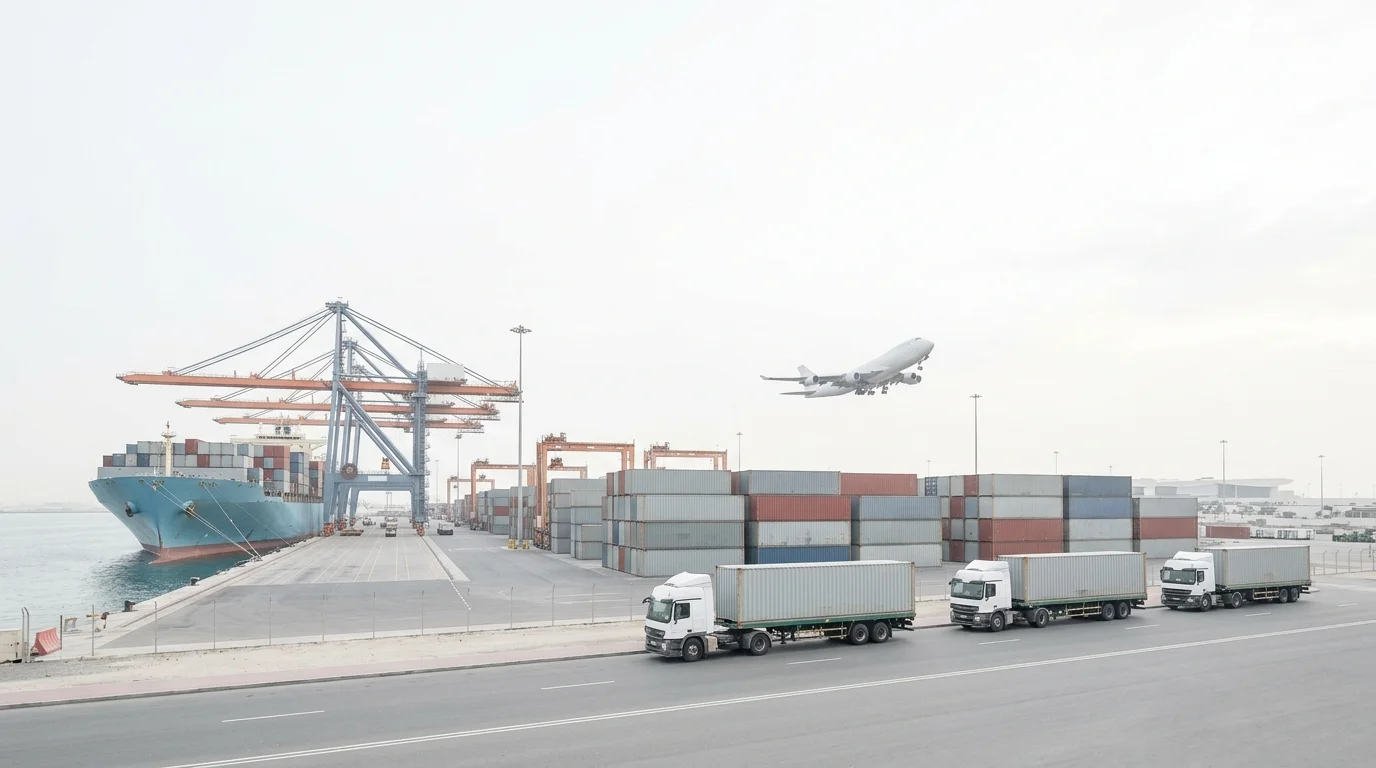
Which shipping method should you choose from Dubai?
Choose sea freight for larger, heavier or less time-sensitive international cargo, air freight for urgent, compact or higher-value shipments, and road freight for suitable UAE and GCC routes. The final choice should rest on packed dimensions, gross weight, commodity restrictions, delivery deadline, destination and the complete door-to-door cost, not the headline freight rate alone.
Sea freight vs air freight vs road freight
| Method | Best used for | Check carefully |
|---|---|---|
| FCL sea freight | Container cargo, heavier loads and less urgent international shipments | Container fit, port cut-offs, sailing schedule, destination charges and free time |
| Air freight | Urgent, compact, time-sensitive or higher-value cargo | Chargeable weight, airline acceptance, airport handling and commodity restrictions |
| GCC road freight | Suitable regional cargo moving within the UAE or to supported GCC destinations | Vehicle type, border procedures, permits, transit route and delivery access |
| Multimodal | Routes that benefit from combining sea, air or road legs | Handover points, document consistency, liability and total end-to-end timing |
Start with the packed cargo, not a preferred method
A useful comparison begins with the exact commodity, package count, packing type, final dimensions and gross weight. These details decide whether the shipment fits standard equipment, how it will be handled and whether a carrier can accept it at all.
Commodity information matters as much as size. Batteries, liquids, chemicals, food, controlled goods and dangerous goods may require special packing, documentation or carrier approval. Simplifying the commodity to move a booking along can invalidate a quotation and delay acceptance.
- Commodity and intended use
- Package count and packing type
- Dimensions and gross weight for every package
- Cargo-ready date and required arrival window
- Pickup point, destination city and delivery requirement
When sea freight is the practical choice
Sea freight usually suits larger, heavier or less urgent cargo moving internationally. Our main focus is full-container load planning, where one shipment uses dedicated container equipment selected around the packed load.
A sea freight comparison should include container positioning, loading, export handling, ocean freight, destination handling, free time and final delivery. A low port-to-port rate becomes expensive once essential origin or destination work turns out to be excluded.
When air freight is worth the higher rate
Air freight is generally worth considering when delivery speed, cargo value or supply-chain urgency justifies the higher transport cost. It suits samples, replacement parts, urgent commercial stock and compact higher-value goods.
Air quotations depend on chargeable weight, which weighs actual weight against shipment volume and charges the greater of the two. Final packed dimensions therefore matter. Airline acceptance, security screening, airport handling and destination clearance all belong in the planning scope as well.
When road freight works for UAE and GCC cargo
Road freight gives direct pickup and delivery on suitable regional routes. Full-truckload or less-than-truckload planning depends on the cargo footprint, weight, vehicle type, border requirements and final delivery access.
For cross-border GCC movements, such as Saudi Arabia, Oman and Kuwait, confirm the countries involved, the intended border route, shipper and consignee records, permits and customs handoffs. Transit estimates should allow for border processing rather than treating driving time as the complete delivery time.
Compare total shipment cost and realistic timing
Ask every provider to quote the same scope. Separate pickup, packing, main freight, documentation, customs coordination, destination handling, duties or taxes, storage and delivery so the differences between quotes are actually visible.
For timing, compare the cargo-ready date, booking lead time, cut-off, planned departure, main transit, customs processing and final delivery. Published schedules are not guarantees, so the live route and space should be reconfirmed before booking.
What to send for a useful method comparison
A freight team can only recommend a method once the shipment brief is complete. Every destination page sets out the gateways, paperwork and delivery options for that country. Send the cargo facts once and ask for sea, air or road alternatives on the same delivery basis, where those options are realistic.
- Clear commodity description, and the HS code if you know it
- Packing list with package-level measurements and weights
- Pickup address and destination city
- Ready date and target delivery window
- Loading, lifting or temperature-control requirements
- Commercial or personal shipment status and declared value
Frequently asked questions
Is sea freight always cheaper than air freight from Dubai?
Sea freight often carries a lower main-freight cost for larger cargo, but it is not automatically cheaper on every shipment. Compare packing, pickup, terminal handling, destination charges, storage and delivery alongside the freight rate before deciding.
What is the fastest shipping method from Dubai?
Air freight is normally the fastest international option for eligible cargo. End-to-end timing still depends on cargo readiness, airline space, screening, flight routing, customs clearance and final delivery.
Can road freight move cargo from Dubai across the GCC?
Road freight serves suitable UAE and supported GCC routes. Availability depends on the cargo, vehicle, border requirements, permits, consignee readiness and current route conditions.
What details are needed to compare shipping methods?
Provide the commodity, package count, packing type, dimensions, gross weight, pickup point, destination city, ready date, delivery deadline and handling needs. Complete cargo facts let each realistic method be compared on the same basis.
Which is cheaper from Dubai, sea freight or air freight?
Sea is cheaper on almost anything heavy or bulky, and the gap widens with weight. Air earns its cost when the deadline cannot move, or when the goods are small and valuable enough that the freight is minor against the cost of the stock sitting idle. Where the choice is genuinely open we price both on your actual cargo rather than arguing from a rule of thumb.
How is air freight chargeable weight calculated?
Air cargo is charged on whichever is greater of the actual weight and the volumetric weight of the packed pieces. Volumetric weight converts the space a shipment occupies into a kilo figure using a standard divisor, so a light, bulky consignment pays for the room it takes on the aircraft. This is why repacking to lose a few centimetres sometimes saves more than negotiating the rate.
When does road freight beat sea freight from Dubai?
On the GCC corridor, almost always. Road avoids two port handlings and reaches an inland city directly instead of delivering to a port and trucking on from there. Outside the Gulf, sea or air is normally the better call. The detail is on land transport from Dubai.
Can I combine air and sea freight on one shipment?
Yes, where the lane supports it. A sea-air routing moves the long leg by sea to a hub and flies the final leg, which sits between the two on both cost and speed. It suits cargo that is too expensive to fly the whole way and too urgent to sail. It needs planning at booking rather than mid-transit.
How do I track a shipment from Dubai?
On whichever reference the mode uses: the bill of lading by sea, the air waybill by air, or the booking reference by road. We send milestone updates against it rather than expecting you to poll a carrier site, and we tell you when something has slipped rather than waiting to be asked.
What is the difference between FCL and LCL?
FCL means booking a whole container at a flat rate per box. LCL means paying by volume for shared space in a consolidation. LCL normally wins below roughly 15 cbm; above that a full container usually costs less per unit and moves faster, because it skips consolidation at both ends. Both are compared on container shipping from Dubai.
Do you handle customs clearance whichever mode I choose?
Yes. Export clearance is prepared before the cargo reaches the port or the terminal, and destination clearance runs through our agent network. The mode changes the transport document, not the need for a declaration that matches it.
What do you need from me to compare the modes properly?
The commodity, the packed dimensions and gross weight per piece, the origin address, the destination address or port, and the date the cargo is ready. If a deadline is driving the decision, say what it is. From that we can price the realistic options side by side instead of guessing which one you wanted.
Which mode suits urgent spare parts from Dubai?
Air, in most cases, because spare parts are usually small, valuable relative to their weight, and needed to end a stoppage that is costing more than the freight. Where the part is heavy or the deadline has room, sea or the GCC road corridor may still be the better answer, and we will say so.
Official and authoritative references
- DP World: Jebel Ali Port
- Dubai Airports: cargo overview
- IMO: verification of the gross mass of a packed container
Not sure which method fits your cargo?
Send the cargo facts once and get sea, air or road priced on the same delivery basis.