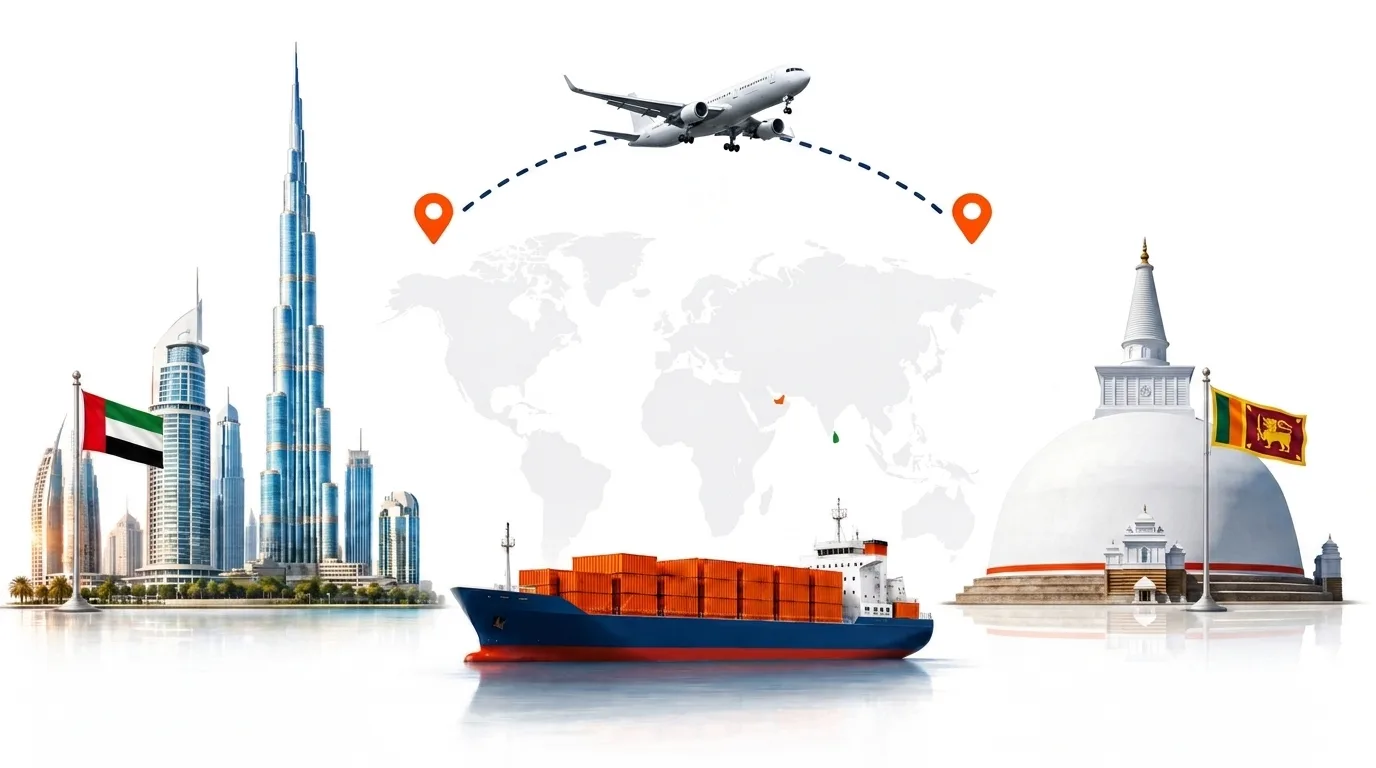
Cargo from Dubai to Sri Lanka

1. Shipping from Dubai to Sri Lanka by sea or air - Cargo from Dubai to Sri Lanka

1. Shipping from Dubai to Sri Lanka by sea or air

Sea freight through Colombo is the standard choice for volume, and this lane benefits from unusually good sailing frequency because Colombo is a major regional hub rather than a secondary port.

Air freight suits urgent, compact or higher-value consignments — spare parts, samples, electronics, apparel-industry inputs against a deadline. Pricing runs on chargeable weight, so bulky low-density cargo prices poorly.

LCL sea freight suits smaller commercial consignments and personal effects — a few pallets, boxed stock, household goods. Consolidation in Dubai and deconsolidation at a Colombo CFS add handling at both ends.

FCL suits full loads, machinery, high volume, or any cargo where a single sealed container simplifies the customs file. Because sailings from Jebel Ali to Colombo are frequent, FCL scheduling on this lane is more flexible than on thinner routes.

Road freight does not apply between the UAE and Sri Lanka.

What changes the choice: packed volume against weight, how firm the deadline is, whether the commodity is subject to import licensing or SLSI conformity, and the final city — though on an island this size the inland leg is a smaller variable than on most routes.

To be quoted properly, send: cargo description and HS code, package count, packed dimensions per piece, gross weight, ready date and final delivery city.

MethodSuitable cargoPrice basisMain consideration
Air freightUrgent, compact, higher-valueChargeable weight (divisor 6000)Volumetric weight can multiply the cost of bulky light cargo
LCL sea freightPallets, boxed stock, personal effectsPer CBM or per 1,000 kg, whichever greaterConsolidation and CFS handling add days at both ends
FCL containerFull loads, machinery, volumePer container by type and routeGood sailing frequency; confirm equipment availability
Road freightNot applicableNo overland route from the UAE

2. What cargo can you ship from Dubai to Sri Lanka?

Most general commercial and personal cargo can be reviewed for Sri Lanka, with the main constraint being import licensing and product-conformity requirements rather than transport availability.

General commercial cargo. Consumer goods, packaged products, textiles, retail stock and general merchandise move regularly by both LCL and FCL.

Apparel and textile industry inputs. Fabric, trims, accessories, dyes and machinery parts for Sri Lanka's garment sector are a significant part of what moves on this lane, often against production deadlines that favour air.

Machinery, equipment and spare parts. Reviewable, with make, model, serial number, condition and technical documentation required. Used machinery may attract additional scrutiny.

Food and agricultural products. Subject to health, sanitary and phytosanitary certification and to import licensing depending on category.

Household goods and personal effects. Commonly moved by the Sri Lankan community in the UAE. A detailed, carton-by-carton inventory is required — generic descriptions cause clearance problems.

Vehicles. Subject to current import policy, which has changed substantially in recent years. See section 10.

Restricted and regulated goods. Items under import licensing, pharmaceuticals, medical devices, telecom equipment, chemicals, cosmetics and goods requiring SLSI conformity all need a check before booking. Import controls were tightened during the 2022 foreign-exchange crisis and relaxed in stages afterwards, so a commodity that could not be imported at one point may be importable now, and the reverse also applies. Verify the current position rather than working from an earlier shipment. Current details must be confirmed before booking.

For special cargo, send: exact product description, HS code, safety data sheet for chemicals or batteries, photographs, packed dimensions and weight, and the intended end use.

3. Sea freight from Jebel Ali to Colombo - Cargo from Dubai to Sri Lanka

3. Sea freight from Jebel Ali to Colombo

Sea cargo from Jebel Ali to Sri Lanka runs to the Port of Colombo, and this is one of the better-served lanes out of Dubai precisely because Colombo is a regional transshipment hub rather than a national port alone.

Origin port: Jebel Ali Port, Dubai Destination ports: Port of Colombo (principal), Hambantota, Galle, Trincomalee

Colombo handles the great majority of Sri Lanka's containerised trade across several container terminals and functions as a relay point for cargo moving between the Gulf, the Indian subcontinent, Southeast Asia and beyond. For a shipper in Dubai the practical consequence is service frequency: more sailings, more carrier choice and a higher likelihood of a direct rather than relayed service than on comparable-sized markets. Section 8 covers what this means in practice.

Hambantota is a southern deep-water port associated with industrial and vehicle-related cargo. It is not the default for general containerised imports and should be quoted only where there is a specific reason.

Galle and Trincomalee have limited container relevance for this lane.

FCL gives a dedicated container and a cleaner clearance file. LCL shares space, requiring consolidation in Dubai and deconsolidation at a Colombo CFS.

Container and equipment choices: 20ft standard for dense cargo, 40ft standard and high-cube for volume, with open-top or flat rack for out-of-gauge machinery. Equipment availability should be confirmed for the booking week.

Port clearance is handled by the consignee or their appointed clearing agent through Sri Lanka Customs, which operates ASYCUDA World. Port charges, clearance costs, inspection and storage sit outside the freight rate unless the quotation says otherwise.

Transport from port to final city. Because the island is compact, the road leg from Colombo to almost any destination is short by the standards of this route set — a genuine cost advantage over comparable markets. Jaffna in the far north is the longest journey and still a manageable single movement.

For a sea-freight quote, send: commodity and HS code, total packed CBM, gross weight, piece count, FCL or LCL preference, ready date, and whether you need port arrival or delivery to a named city address.

4. Air cargo from Dubai to Sri Lanka

Air cargo from Dubai to Sri Lanka runs to Bandaranaike International Airport at Katunayake, which serves the whole island rather than a single region.

Origin airports: DXB, DWC Destination airport: Bandaranaike International Airport (CMB); Mattala (HRI) has limited relevance Current details must be confirmed before booking.

Because Sri Lanka is served by essentially one air cargo gateway, the airport decision that complicates larger markets does not arise here. The relevant questions are carrier, service and timing rather than which airport to use.

Air suits urgent, compact or higher-value consignments — apparel-industry inputs against a shipment deadline, machine spares, electronics, samples and time-sensitive stock.

Actual weight versus chargeable weight. Airlines charge on the higher of actual gross weight and volumetric weight, calculated as length × width × height in centimetres divided by 6000, the IATA standard divisor. Measuring cartons accurately before requesting a rate avoids most quotation surprises on this lane.

Airline cargo acceptance depends on commodity, packing, labelling and documentation. Batteries, aerosols, chemicals and magnetised goods require dangerous-goods review before booking.

Airport clearance is handled by the consignee or their clearing agent. Airport storage accrues quickly, so the consignee should be prepared to clear on arrival.

Delivery from the airport. CMB sits near Negombo, north of Colombo, so delivery into the Colombo commercial area is a short road movement. Onward delivery to any other city on the island is a single-day road leg.

For an air-freight quote, send: piece count, packed dimensions per piece, gross weight, commodity description and HS code, whether the goods are regulated, and the destination city.

5. Cargo shipping rates from Dubai to Sri Lanka

There is no single per-kilogram or per-container price for Sri Lanka; the rate is built from the shipment's own measurements and current route conditions on your booking date.

Air rate basis. Chargeable weight at a rate band that steps down as weight increases, plus security screening, airline surcharges and documentation.

LCL rate basis. Per cubic metre or per 1,000 kg, whichever produces the higher figure, plus consolidation at origin and CFS handling at destination.

FCL rate basis. Per container by equipment type and route, plus terminal handling at both ends.

Pickup and packing. Collection in Dubai or the wider UAE, priced by location, access and volume. Export packing, crating and palletising quoted separately.

Origin handling. Export documentation, terminal handling at Jebel Ali, UAE export processing.

Destination handling. Terminal or CFS handling, delivery order fees, port charges.

Customs, duties and taxes. Assessed in Sri Lanka against the HS classification and declared value, plus VAT and any applicable levies. Payable by the importer and outside the freight quotation.

Import licence and conformity costs. Where an import licence or SLSI conformity documentation is required, obtaining it carries its own cost and lead time.

Final delivery. Road transport from Colombo to the final city. Because distances are short, this is a smaller component of the total than on most routes — one of the practical advantages of the lane.

Worked example

Cargo: 10 cartons of apparel trims and accessories Method: Air freight, DXB → CMB Weight: 140 kg actual (14 kg per carton) Dimensions: 70 × 50 × 45 cm per carton Assumptions: IATA volumetric divisor of 6000; airport-to-airport scope; no dangerous goods Example calculation:

  • Volume per carton = 70 × 50 × 45 = 157,500 cm³
  • Volumetric weight per carton = 157,500 ÷ 6000 = 26.25 kg
  • Volumetric weight total = 26.25 × 10 = 262.5 kg
  • Actual weight total = 140 kg
  • Chargeable weight = 262.5 kg (the higher figure)

The consignment bills as 262.5 kg against an actual 140 kg — an 87% uplift created entirely by carton dimensions. Repacking into denser cartons is often the single cheapest saving available on an air shipment of this type.

Source/date: IATA volumetric divisor of 6000 is the standard industry basis for air freight chargeable weight. Current details must be confirmed before booking.

Important limitation: This shows how chargeable weight is derived, not what your shipment will cost. The rate per kilogram depends on commodity, capacity, routing and booking date, and origin handling, destination charges, duty and inland delivery are additional.

6. Dubai to Sri Lanka shipping times

Air cargo to Colombo is measured in days and sea freight in weeks, and because direct sailings are common on this lane the sea estimate is more dependable than on routes that rely on transshipment.

MethodEstimated main transitExtra delivery stepsSource and date
Air freightRequest a current shipment estimateAirport clearance, storage release, road deliveryCurrent details must be confirmed before booking.
LCLRequest a current shipment estimateConsolidation cut-off, CFS deconsolidation, clearance, road deliveryCurrent details must be confirmed before booking.
FCLRequest a current shipment estimateTerminal handling, clearance, container release, road deliveryCurrent details must be confirmed before booking.
Road freightNot applicable

What changes the actual delivery time: the sailing or flight actually booked rather than the fastest advertised service; whether the service is direct or relayed; LCL consolidation waiting for the container to fill; terminal and airline cut-offs against your ready date; customs processing through ASYCUDA World and whether the declaration is selected for examination; import licence or conformity status where applicable; and the road leg from Colombo, which on this island is short.

Ask for the carrier transit and the estimated end-to-end window as two separate figures, and reconfirm both when the cargo is ready to book.

7. Sri Lanka customs documents and clearance - Cargo from Dubai to Sri Lanka

7. Sri Lanka customs documents and clearance

Commercial shipments to Sri Lanka start with the standard trade documents, with import licensing and product conformity being the two areas that most often need arranging in advance.

Commercial invoice. Shipper and consignee details, itemised goods description, quantities, unit and total value, currency, Incoterm.

Packing list. Piece count, contents per package, dimensions and weight per package. For personal effects, itemised by carton.

Bill of lading or air waybill. Issued against the booking. Confirm whether the B/L is original or telex-released, as this affects how quickly the consignee can take delivery.

Certificate of origin. Required for certain commodities and for any preferential duty claim. Issued through the relevant UAE chamber of commerce.

HS code. Determines duty rate, licensing requirement and inspection routing. Classification should be confirmed by the Sri Lankan importer or their clearing agent before the cargo leaves Dubai.

Import licence. Certain categories require a licence from the Department of Import and Export Control. Licensing has changed materially in recent years, so the requirement for a specific commodity should be checked currently rather than assumed. Current details must be confirmed before booking.

SLSI conformity. Products falling under Sri Lanka Standards Institution requirements need the relevant conformity documentation. Establish this before shipping, not on arrival.

Health, sanitary and phytosanitary certificates. Applicable to food, agricultural and animal-origin products.

Importer responsibilities. The Sri Lankan consignee files the declaration through ASYCUDA World, pays duty, VAT and levies, holds any required licence, and appoints a clearing agent. Navo Shipping coordinates transport and documentation; the importer confirms destination eligibility.

Official reference URLs

  • Sri Lanka Customs — Current details must be confirmed before booking.
  • Department of Import and Export Control — Current details must be confirmed before booking.
  • Sri Lanka Standards Institution — Current details must be confirmed before booking.

8. Why Colombo Port works well for Sri Lanka cargo

Sri Lanka is a small market served by one of the region's major transshipment hubs, and that combination produces a shipping profile most comparable destinations do not have — better service frequency arriving at a port from which the entire country is reachable in a single road movement.

Most competitor pages treat Colombo as simply "the port". The more useful point is why it behaves differently from a port serving a market of similar size.

Service frequency is the practical benefit. Colombo's role as a relay point between the Gulf, the Indian subcontinent and Southeast Asia means carriers call there far more often than the country's own import volume alone would justify. For a Dubai shipper this shows up as more sailing options, more carrier choice, better odds of a direct service rather than a relayed one, and less schedule pressure when a booking slips. On thinner lanes a missed cut-off can cost a fortnight; here the next option is usually closer.

Direct import versus transshipment cargo. Because Colombo handles large volumes of cargo that is only passing through, it is worth being explicit that your consignment is an import for domestic clearance rather than relay cargo. This affects terminal handling and documentation, and confusion here is an avoidable source of delay. State the final destination clearly on the booking.

The whole island is one delivery zone in practical terms. Sri Lanka's compactness means the road leg from Colombo to almost any city — Kandy in the central highlands, Galle on the southern coast, Kurunegala, Anuradhapura, even Jaffna at the northern tip — is a single-day movement. Compare that with the route set Navo Shipping handles elsewhere: a Karachi arrival for a Lahore consignee, or a Novorossiysk arrival for a Moscow consignee, involves an inland leg that can rival the sea transit in complexity and cost. Here it does not.

What that changes in your planning. Two things. First, the port-versus-door decision is less consequential — the gap between a Colombo port price and a door price to most cities is modest, so door delivery is often worth taking. Second, FCL becomes economical at lower volumes than on routes with heavy inland costs, because you are not paying a long-haul road leg on top of the container.

The constraint sits elsewhere. With transport this straightforward, delays on the Sri Lanka lane come from documentation, licensing and conformity rather than from moving goods. That is where planning effort is best spent — confirm the licence and conformity position for your commodity early, and the physical movement generally takes care of itself.

Sources

  • Current details must be confirmed before booking.
  • Current details must be confirmed before booking.
9. Cargo delivery to cities across Sri Lanka - Cargo from Dubai to Sri Lanka

9. Cargo delivery to cities across Sri Lanka

Shipping to Colombo

Colombo is both the arrival port and the commercial centre, so cargo destined there completes its journey without a meaningful inland leg.

Sea cargo clears at the Port of Colombo and delivers locally. Air cargo arrives at Bandaranaike International Airport, roughly north of the city, and reaches the commercial districts in a short road movement.

Commonly sent: general commercial stock and consumer goods, apparel-industry inputs, machinery and spare parts, office and retail equipment, and household goods for relocating families.

Main consideration: because there is no long inland leg, the total delivered cost for Colombo is the lowest on the island and FCL becomes viable at lower volumes than for most destinations. The variables that matter are clearance speed, port storage and whether the delivery site can receive a container — not transport distance.

For delivery pricing, send: the delivery address and district, piece count, weight and CBM, and whether the site has container access and unloading capability.

Shipping to Kandy

Kandy sits in the central highlands, and the road leg from Colombo is short in distance but slower than the map suggests because of the terrain and road conditions on the climb inland.

Cargo clears at Colombo and travels inland by road. The journey is comfortably a single day, but it is not a motorway run, and vehicle size is a real constraint on the approach into the city and its surrounding areas.

Commonly sent: commercial stock for the central province, machinery and spare parts, hospitality and tourism-sector supplies, and household goods.

Main consideration: confirm delivery-site access before booking a full container. Sites that cannot receive a 40ft trailer are common in the hill country, and discovering this on arrival means an unplanned transfer to smaller vehicles at additional cost. Where access is uncertain, LCL or a 20ft container is often the more practical choice even when a 40ft would be cheaper per cubic metre.

For delivery pricing, send: the delivery address, weight and CBM, and confirmation of vehicle access and unloading capability at the site.

Shipping to Jaffna

Jaffna on the northern peninsula is the longest inland journey on the island, and still a single road movement from Colombo — which puts it in a different category from the inland destinations on most other routes.

Cargo clears at Colombo and travels north by road. The leg is priced by distance, weight and vehicle type, and while it is the highest inland cost in Sri Lanka, it remains modest compared with the inland legs on the Pakistan or Russia routes.

Commonly sent: general commercial and consumer goods for northern distribution, construction and building materials, agricultural equipment, and household goods.

Main consideration: consolidate where possible. Because the road leg is the main variable cost for Jaffna, combining consignments into fewer, fuller movements has more effect on the total than optimising the sea freight. Where volumes are regular, ask about scheduled rather than ad-hoc inland delivery.

For delivery pricing, send: the delivery address, weight and CBM, ready date, and whether delivery can be scheduled with other consignments.

Other destinations

CityClearing gatewayInland transportMain planning point
NegomboCMB air / Colombo portVery short road legClosest city to the air gateway; useful for urgent air consignments
GalleColombo portRoad, southern coastal routeWell-connected southern route; straightforward delivery
MataraColombo portRoad, southern coastal routeExtension of the Galle corridor
KurunegalaColombo portRoadCentral distribution point; good access
AnuradhapuraColombo portRoad, north-central routeLonger leg; consolidate where volumes allow
TrincomaleeColombo portRoad, eastern routeOwn port exists but has limited container relevance; road from Colombo is usual
BatticaloaColombo portRoad, eastern routeLonger eastern leg; confirm vehicle access

10. Car shipping from Dubai to Sri Lanka

Vehicle enquiries for Sri Lanka can be reviewed for transport, but the import position is the governing question and it has changed substantially in recent years — no figure or eligibility statement should be relied upon without a current check.

Container shipping. Vehicles move from Jebel Ali in containers, individually in a 20ft or shared in a 40ft where the cargo mix permits.

RoRo. Availability into Sri Lankan ports is service-dependent. Current details must be confirmed before booking.

Import eligibility — the critical point. Sri Lanka suspended most vehicle imports from 2020 as part of measures addressing the foreign-exchange crisis, and relaxation has been announced in phases since. This means the answer to "can I import a car" has been different at different times, and an answer from an older article or a previous shipment is not reliable.

Age limit and category restrictions.

Documents. Original registration or export certificate, purchase invoice, chassis and engine numbers, technical specification, ownership documentation, and photographs including the VIN plate.

Customs valuation. Duty and levies are assessed on a customs value determined by Sri Lanka Customs, which may differ from your purchase price. On vehicles, the duty and levy component has historically been very substantial relative to the vehicle value, and the consignee should obtain a landed-cost estimate before committing.

Final delivery. From Colombo to the final city by road.

For a quote, send: make, model, year, chassis number, engine capacity and type, condition, running or non-running, dimensions, ownership documents, and destination city.

Official vehicle-rule URL: Current details must be confirmed before booking. Access date:

11. Common Dubai to Sri Lanka cargo delays

Transport on the Sri Lanka lane is comparatively straightforward, so almost every delay traces back to documentation, licensing or conformity rather than to moving the goods.

Missing import licence. Where a commodity requires a licence and it has not been obtained before shipment, the cargo waits. This is the most avoidable delay on the route and the one most often caused by relying on outdated information about what is controlled.

Missing or incorrect SLSI conformity documentation. Products falling under standards requirements held pending certification that should have been arranged in advance.

HS classification disputes. Disagreement over classification or declared value holds the consignment pending assessment while storage accrues.

Vague cargo descriptions. "General goods" or "machine parts" invites a query. Specific, itemised descriptions matched to an HS code clear faster.

Personal effects without an itemised inventory. A recurring and entirely avoidable problem. Carton-by-carton inventories prevent it.

Missing health or phytosanitary certificates. Food and agricultural consignments held for certification.

Customs examination. Declarations routed for physical examination through ASYCUDA World. Normal, and worth building into the delivery window rather than treating as a failure.

LCL consolidation waits. Cargo waiting for a container to fill at origin, which affects the departure date rather than the sailing.

Delivery-site access. Sites in the hill country and smaller towns that cannot receive a full-size trailer. Confirm access before booking a 40ft container.

Port storage accrual. Where clearance is slow, storage costs mount at Colombo. A consignee prepared to clear promptly is the single best protection.

12. Get a cargo quote from Dubai to Sri Lanka

Please provide:

  • Exact cargo description
  • Intended use (commercial resale, personal, industrial)
  • HS code, where known
  • Number of packages
  • Packing type (cartons, pallets, crates, loose)
  • Packed dimensions per piece (L × W × H in cm)
  • Gross weight per piece and total
  • Cargo value and currency
  • UAE pickup address
  • Destination city and delivery address in Sri Lanka
  • Confirmation of vehicle access and unloading capability at the delivery site
  • Ready date
  • Photographs, safety data sheets, licences or conformity documents where relevant
  • Required delivery scope: port-to-port, airport-to-airport, or door delivery

13. Frequently asked questions

1. What is the best shipping method from Dubai to Sri Lanka? Sea freight from Jebel Ali to the Port of Colombo is the standard choice for heavy or bulky cargo, and the lane benefits from good sailing frequency because Colombo is a major regional hub. Air cargo to Bandaranaike International Airport suits urgent or compact consignments. The right method depends on packed volume against weight and your deadline.

2. How much does shipping to Sri Lanka cost? Air freight is priced on chargeable weight — the higher of actual and volumetric weight. LCL is priced per cubic metre or per 1,000 kg, whichever is greater. FCL is priced per container. Origin handling, destination charges, duty and inland delivery are additional, though the inland component is smaller here than on most routes because distances are short.

3. How long does shipping take? Air cargo is measured in days and sea freight in weeks. Because direct sailings between Jebel Ali and Colombo are common, sea estimates on this lane are more dependable than on routes relying on transshipment. Clearance and the short road leg to your final city add further time; ask for carrier transit and the end-to-end window separately.

4. Is door-to-door shipping available? Yes, and it is often worth taking on this route. Because the entire island is within a single day's road movement of Colombo, the gap between a port price and a door price is modest compared with destinations that involve long inland legs. Confirm what the quotation includes — duty, taxes, inspections and storage are commonly outside the freight price.

5. What documents are required? A commercial invoice, packing list, and bill of lading or air waybill are the starting point, usually with a certificate of origin. Certain categories require an import licence from the Department of Import and Export Control, and products under Sri Lanka Standards Institution requirements need conformity documentation. Personal effects need an itemised inventory.

6. Which goods need special approval? Licensed categories, food and agricultural products, pharmaceuticals, medical devices, telecom equipment, chemicals and cosmetics commonly require additional documentation or approval. Import controls were tightened during the 2022 economic crisis and eased in stages afterwards, so verify the current position for your commodity rather than relying on older guidance.

7. Which port or airport should I use? The Port of Colombo handles the great majority of containerised imports and is the practical choice for sea freight; Hambantota is relevant only for specific industrial or vehicle cargo. For air, Bandaranaike International Airport is effectively the single cargo gateway and serves the whole island.

8. Can I ship a car to Sri Lanka? Vehicle transport can be arranged, but Sri Lanka's import position has changed substantially since 2020 and the current rules must be confirmed with Sri Lanka Customs or a local clearing agent before any commitment. Duty and levies on vehicles have historically been very high relative to vehicle value, so obtain a landed-cost estimate first.

14. Final CTA

Heading: Tell us what you are shipping to Sri Lanka.

Text: Share the cargo description, HS code where known, package count, packed dimensions and weight, UAE pickup location, destination city in Sri Lanka and your ready date for a route-specific review.

Tell us what you are shipping.

Share the cargo details for a route-specific review.

Share shipment details