
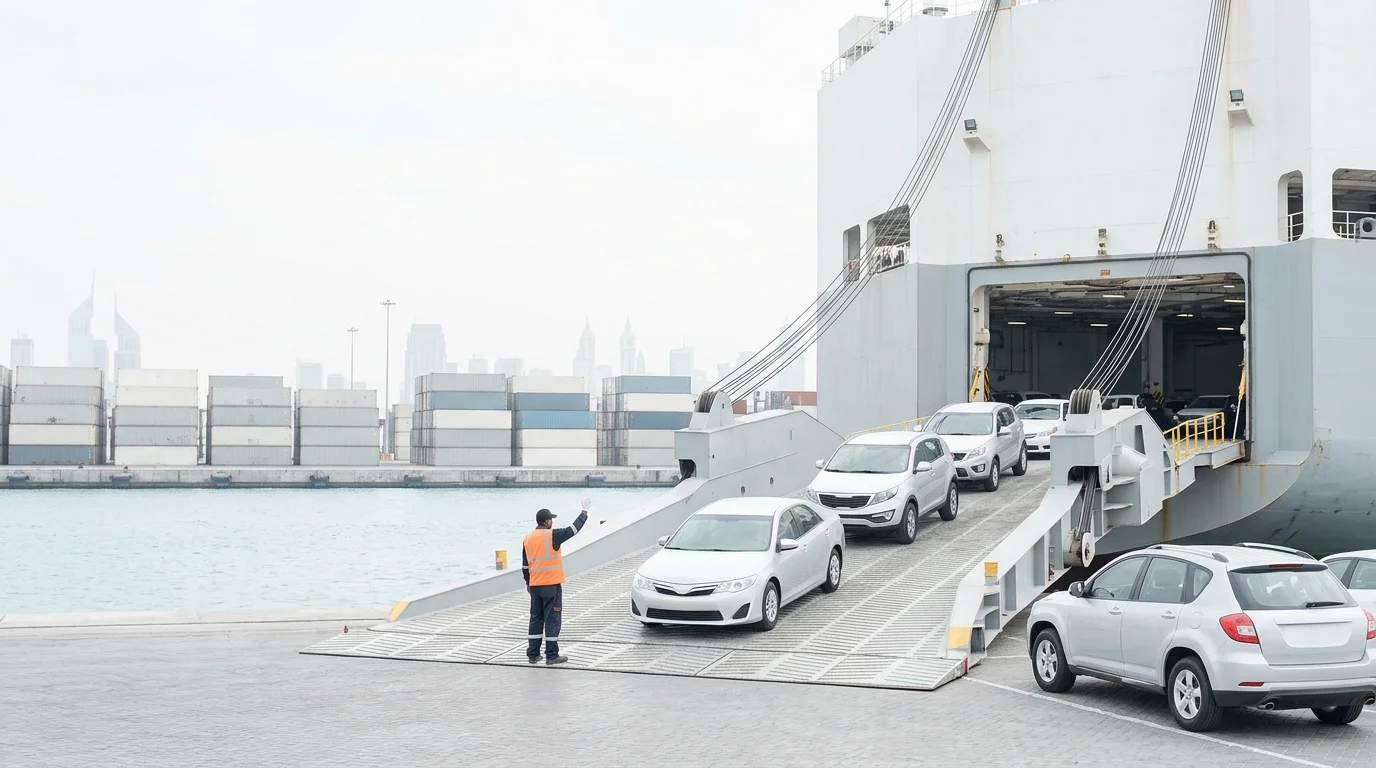
If you are exporting one running vehicle to a port that handles RoRo, RoRo is almost always cheaper. If you are shipping two or more, or the destination has no RoRo call, a container usually wins. The destination country decides more of this than most people expect, so check its rules before you check the price.
Should I ship my car from Dubai by RoRo or in a container?
One running car to a RoRo port: choose RoRo. Two or more cars, a non-running car, a low clearance or high value car, or a destination with no RoRo service: choose a container. Everything else is detail. We quote both side by side on car shipping from Dubai so you can see the difference rather than take our word for it.
How RoRo works
Roll-on roll-off means the vehicle is driven onto a dedicated vessel deck, secured with straps, and driven off at arrival. There is no packing, no crane lift and no container to unstuff, which is why the handling cost is lower and the port turnaround is quicker. Our RoRo shipping service covers the loading, the lashing and the paperwork at both ends.
- Best for running, road legal vehicles that can be driven on and off
- Usually the cheapest option on lanes with regular RoRo calls
- Nothing may be packed inside the vehicle, and customs do check
- Arrival is limited to ports with a RoRo ramp and terminal
- The car sits on an open or enclosed deck, exposed to sea air either way
How container shipping works
The vehicle is loaded and braced inside a 20ft or 40ft container and booked as FCL sea freight. A 40ft high cube typically takes two to four cars depending on size, which is where the cost per vehicle drops below RoRo. Bracing is a skilled job: a car that moves in transit damages itself and everything around it.
- Works to any container port, so far more destinations are reachable
- The vehicle is enclosed and out of the weather for the whole voyage
- Personal effects can travel with it where the destination allows
- Non-running, classic, modified and high value cars all belong here
- Loading, bracing and unstuffing add handling cost at both ends
What decides it in practice
Check the destination first, because it can settle the question before price enters it. Many countries set an age limit on imported vehicles, some require right hand drive, some require a pre-shipment inspection carried out before the car leaves Dubai, and a few restrict used vehicle imports almost entirely. None of that can be fixed after the vehicle has sailed. Find your country on the destination pages and the rules for it are set out there.
Then count the units. A single running car is cheapest on RoRo. Two or more almost always justify a container, because the freight is charged on the box rather than per vehicle. Finally look at the car itself. If it does not run, sits low enough to catch on a ramp, is worth protecting from salt air, or is going somewhere with no RoRo service, the container is the answer regardless of unit count.
Where each one sails from Dubai
RoRo works best on the established used vehicle lanes out of the Gulf, which is why East and West Africa carry most of the traffic. Container shipping reaches everywhere else, including markets where no RoRo vessel calls at all.
- East Africa is the busiest RoRo market from Dubai, into Kenya, Tanzania, Uganda and Somalia
- West Africa takes volume into Nigeria, Ghana and Benin
- Southern Africa runs through South Africa and Mozambique
- The Caucasus and Central Asia move mostly by container through Georgia
- Island markets such as Mauritius and New Zealand are container territory, and New Zealand adds a biosecurity clean before the car is released
What moves the price
We do not publish a rate for either method, because a rate that ignores the destination is a number that will change once you ask for it. What we can tell you is what the total is built from, so you can compare two quotes properly and see which one has left something out.
| Cost line | RoRo | Container |
|---|---|---|
| Ocean freight | Charged per vehicle, by size band | Charged per container, whatever is inside it |
| Origin handling | Delivery to the terminal and the export declaration | Delivery, loading, bracing and the export declaration |
| Destination handling | Terminal charge and release | Terminal charge, unstuffing and release |
| Inspection | Where the destination requires one before shipping | Same, and it must be done in Dubai |
| Duty and tax | Assessed by the destination on the vehicle | Assessed the same way, on the vehicle not the box |
| Delivery | Driven or trucked from the port | Trucked from the port after unstuffing |
Duty is the line people forget. It is set by the destination country against the vehicle age, engine size and value, it is not part of the freight, and it is often the largest single number in the whole exercise. We flag it at quote stage rather than at arrival, and our customs clearance team handles the declaration at both ends.
Preparing the car before it ships
- Wash the car, inside and underneath. Several countries inspect for soil and seeds, and a dirty underbody is a common reason for a hold
- Run the tank low. Carriers set a limit on how much fuel may be aboard
- Disable or explain the alarm, and hand over a spare key with the vehicle
- Remove toll tags, loose items and anything in the boot unless the destination allows personal effects
- Photograph the car from every side on the day it is handed over, so any damage claim starts from evidence
- Check the chassis number on the registration matches the car, because customs at the far end will
Documents you will need either way
- Original vehicle registration, or the export certificate once the car is deregistered in the UAE
- Commercial invoice or purchase agreement showing what was paid
- Passport copy of the exporter, and the buyer details at the far end
- Any pre-shipment inspection certificate the destination requires
- A bill of lading, which we raise once the vehicle is loaded
The document set for a vehicle is close to the one for general cargo, with the registration taking the place of a packing list. If you are shipping other goods in the same period, the export document checklist covers the rest.
Common mistakes
- Buying the car before checking the destination age limit. This is the expensive one, and it cannot be undone once the car is bought
- Packing belongings into a RoRo vehicle. They are not permitted and the car can be held
- Booking on price alone when the cheaper method does not serve the arrival port
- Leaving the inspection until arrival, when the destination required it before loading
- Assuming duty is included in the freight quote. It never is
Send us the make, model, year, chassis number and destination, and we will come back with RoRo and container priced side by side, the rules that apply in that country, and the transit time on the next available sailing.
Frequently asked questions
Is RoRo cheaper than a container for shipping a car from Dubai?
For one running vehicle to a port with a regular RoRo call, usually yes, because there is no packing, no bracing and no unstuffing to pay for. For two or more vehicles the container normally wins, since the freight is charged on the box rather than per car. We quote both so you can see the gap on your own lane rather than rely on a rule of thumb.
Can I put personal belongings inside the car?
Not on RoRo. Vessels do not permit it and customs check, so a loaded car can be held or refused. In a container it is often allowed, depending on the destination, and the belongings are then declared as part of the shipment rather than hidden in the boot. Tell us what you want to send and we will confirm what that country accepts.
Can you ship a car that does not run?
Yes, in a container. A non-running vehicle cannot be driven onto a RoRo deck, so it is winched or forklifted into a container and braced there. Tell us at booking, because it changes the loading method and the equipment we need at the terminal.
How many cars fit in a container?
A 40ft high cube typically takes two to four, depending on the size and shape of the vehicles and whether they are racked. A 20ft normally takes one. The exact number is worked out from the actual cars, not from a table, because a pair of large SUVs and a pair of hatchbacks are not the same problem.
Do I need an inspection before the car leaves Dubai?
Some destinations require one, carried out before loading, and the certificate travels with the shipment. It cannot be arranged after the car has sailed. We check what your destination requires at quote stage and arrange the inspection in Dubai if it applies.
What documents do I need to export a car from Dubai?
The vehicle registration or export certificate, a commercial invoice or purchase agreement, a passport copy of the exporter, and any inspection certificate the destination requires. We raise the bill of lading once the vehicle is loaded and handle the export declaration in Dubai.
Is duty included in the shipping price?
No. Duty and tax are charged by the destination country on the vehicle itself, assessed against its age, engine size and value, and they are separate from the freight. On many lanes duty is the largest single cost in the whole move, so we flag it at quote stage rather than let it appear on arrival.
Which countries can you ship a car to from Dubai?
Most, but the rules differ sharply and a few restrict used vehicle imports almost entirely. Age limits, drive side and inspection requirements are all set by the destination. Find your country on the destination pages and the rules for it are set out there, or send us the make, model and year and we will confirm before you commit.
How long does it take to ship a car from Dubai?
It depends on the destination port, whether the service is direct or transhipped, and how often a service calls there. RoRo matters more on this point than a container does, because the RoRo network reaches far fewer ports, so a missed sailing can mean a real wait. Add clearance and any inspection at the far end, which is not part of the sailing. We confirm the transit for your destination and the specific sailing before you book.
Can I track my vehicle during shipping?
Yes. A container tracks on the bill of lading number; a RoRo unit tracks against the booking and the vessel schedule. We confirm loading, departure and arrival, and send the condition photographs taken at handover so you have a record of how the vehicle left.
Is the car insured during the voyage?
Not automatically. Carrier liability is limited by convention and is not the same as insuring the vehicle for its value, and RoRo liability is lower than most owners expect. Marine cargo insurance is arranged separately against a declared value. It is worth taking on anything valuable, classic or hard to replace.
Do you handle customs clearance at both ends?
Export clearance in Dubai is prepared before the vehicle is delivered to the port, and our agent files the import entry at destination. The import side is where vehicle shipments usually stall, because age limits, drive side and conformity are checked there rather than here, so we confirm eligibility before you commit.
Can I ship an electric vehicle from Dubai?
Electric and hybrid vehicles can be shipped, but the battery makes them dangerous goods, and acceptance depends on the carrier, the state of charge and whether the car travels in a container or on a RoRo deck. Some services decline them outright. Send the make, model and battery type at enquiry and we confirm acceptance before booking.
What happens if the car is damaged in transit?
The condition report and photographs taken before loading are what any claim rests on, which is why we take them at handover. Damage found on arrival has to be noted at the point of delivery, before the vehicle leaves the terminal, or the claim becomes very hard to pursue. Where marine insurance is in place the claim goes to the insurer; where it is not, carrier liability applies and it is limited.
Official and authoritative references
Exporting a vehicle from Dubai?
Send the details and get RoRo and container prices in the same reply.