
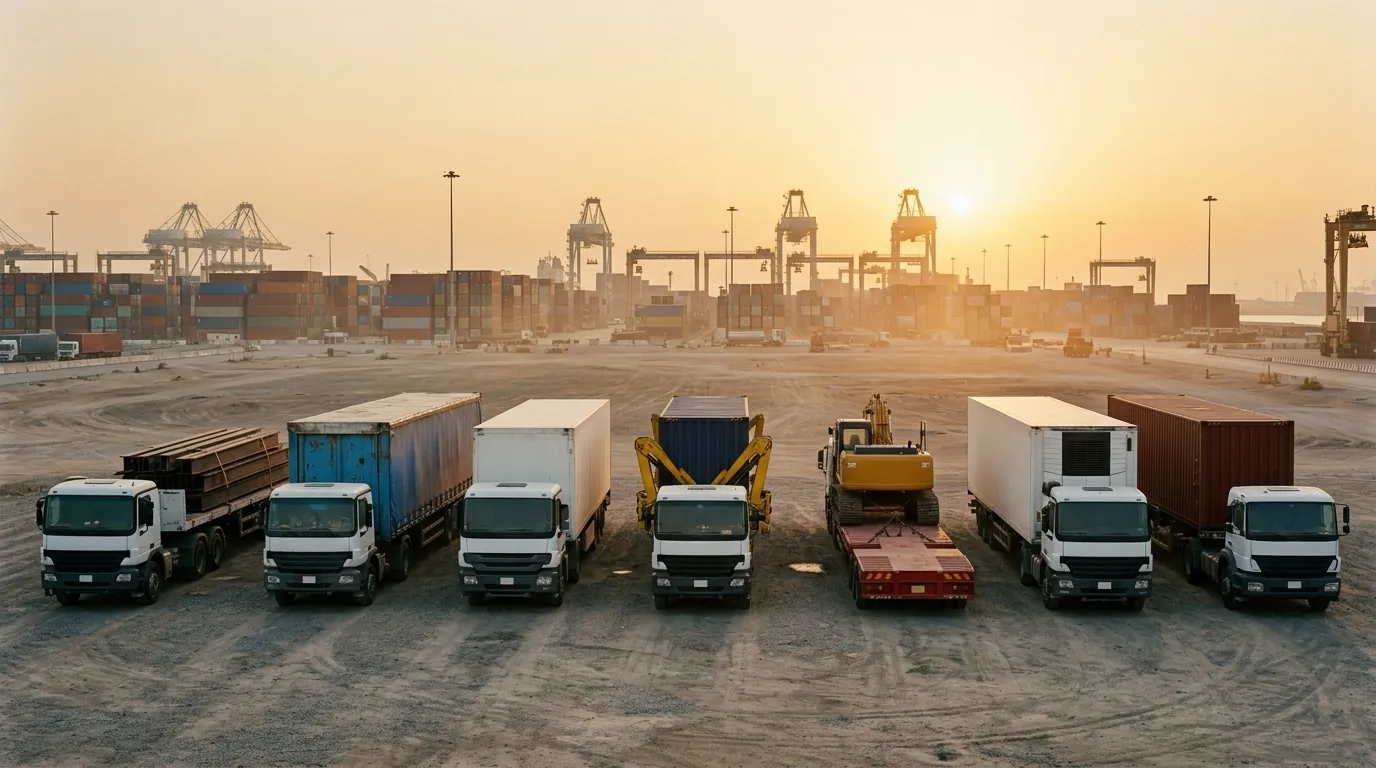
What are the main types of trailers in the UAE and GCC?
There are seven main types of trailers for road cargo in the UAE and the GCC: flatbed, curtain-side, box, side loader, lowbed, reefer and container chassis. Pick the trailer by the cargo, not the other way round. Steel and machinery go on a flatbed. Pallets go in a curtain-side or a box. Heavy plant goes on a lowbed. Food and medicine go in a reefer. Containers go on a chassis or a side loader. Navo Shipping is a shipping company in Jebel Ali, and we arrange local transport across the UAE and road freight across the GCC.
Trailer types compared: body, loading and best use
Every trailer here is pulled by the same kind of truck. What changes is the body behind it, and the body decides three things: what the cargo is protected from, how it gets loaded, and what it can carry.
| Trailer | Body | How it loads | Best for |
|---|---|---|---|
| Flatbed | Open deck, no sides, no roof | Crane or forklift, from any side or from above | Steel, pipes, timber, machinery, building materials |
| Curtain-side | Roof and floor, with curtains that slide open along both sides | Forklift from the side, or through the rear doors | Pallets, cartons, general cargo, furniture |
| Box | Solid walls and roof, doors at the back | From the rear, at a loading dock or by forklift | Retail stock, electronics, household goods, anything that must stay dry and locked |
| Side loader | Container trailer with two hydraulic cranes | Lifts the container itself on and off the ground | 20ft and 40ft containers where there is no crane on site |
| Lowbed | Deck that sits close to the road, often with ramps | Driven up the ramps, or lifted on by crane | Excavators, loaders, generators, tall machinery |
| Reefer | Insulated box with a fridge unit at the front | From the rear, ideally at a cold store dock | Chilled and frozen food, fruit and vegetables, flowers, medicines |
| Container chassis | Steel frame with corner locks, no floor | Container set on top by a port crane or reach stacker | Moving 20ft and 40ft containers between port, depot and warehouse |
Flatbed trailer: open deck for steel, pipes and machinery
A flatbed trailer is a flat steel deck on wheels. There are no sides and no roof, so cargo can be loaded by crane from above or by forklift from any side. That makes it the first choice for long, heavy or awkward pieces: steel beams, rebar, pipes, timber, precast concrete, cable drums and machinery. Loads are held down with chains and straps, and covered with a tarpaulin when the weather or the goods call for it.
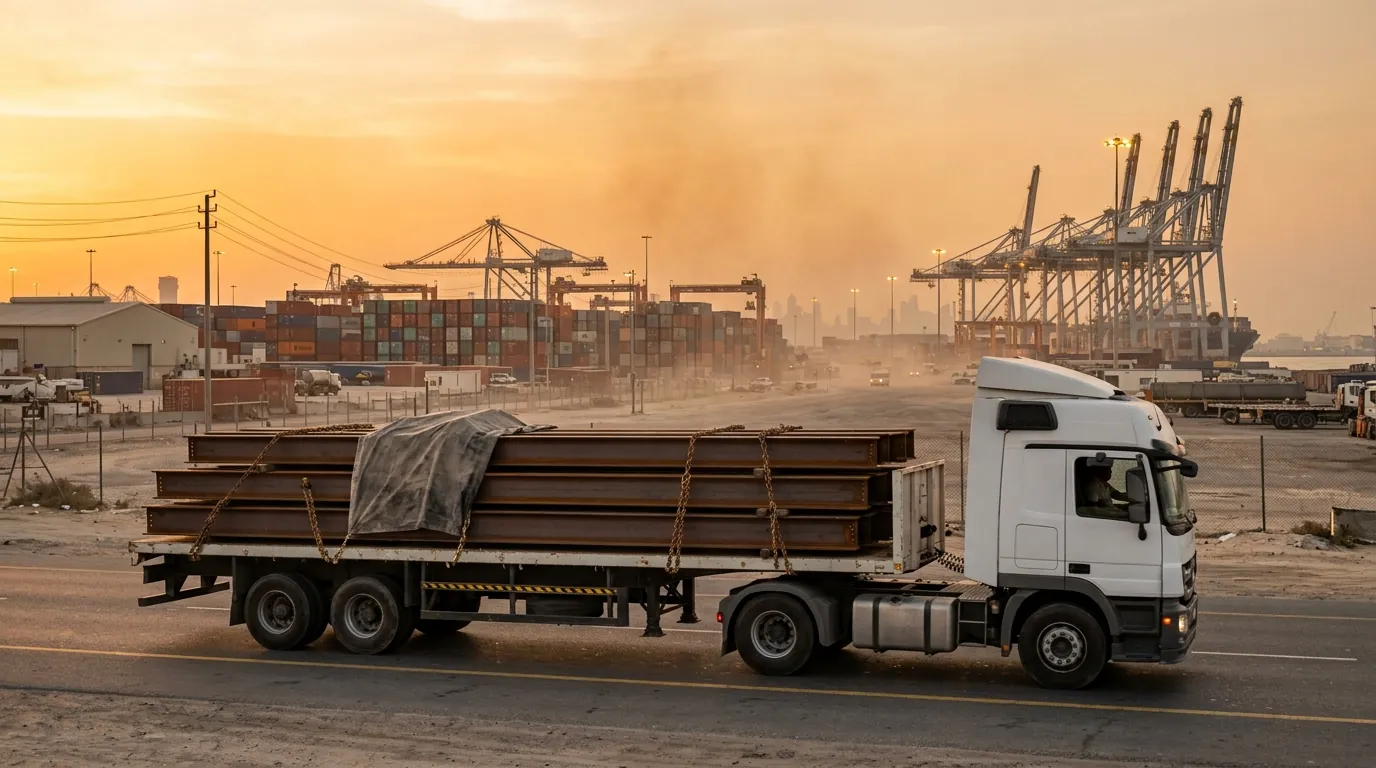
On construction and industrial work in the UAE, the flatbed is one of the most common trailers on the road, and many flatbeds in the Gulf have container locks fitted, so they can carry a 20ft or 40ft container when no chassis is free. Its limit is height. A flatbed deck sits higher than a lowbed, so a tall machine can end up too tall for the road, and that is when it moves to a lowbed instead.
Curtain-side trailer: pallets loaded from the side
A curtain-side trailer, or curtainsider, has a roof and a floor like a box, but its sides are strong fabric curtains that slide back along a rail. Open them and a forklift can reach every pallet from the side, so loading is quick and nothing has to be shuffled to the back. Close them and the cargo is covered from sun, sand and rain.
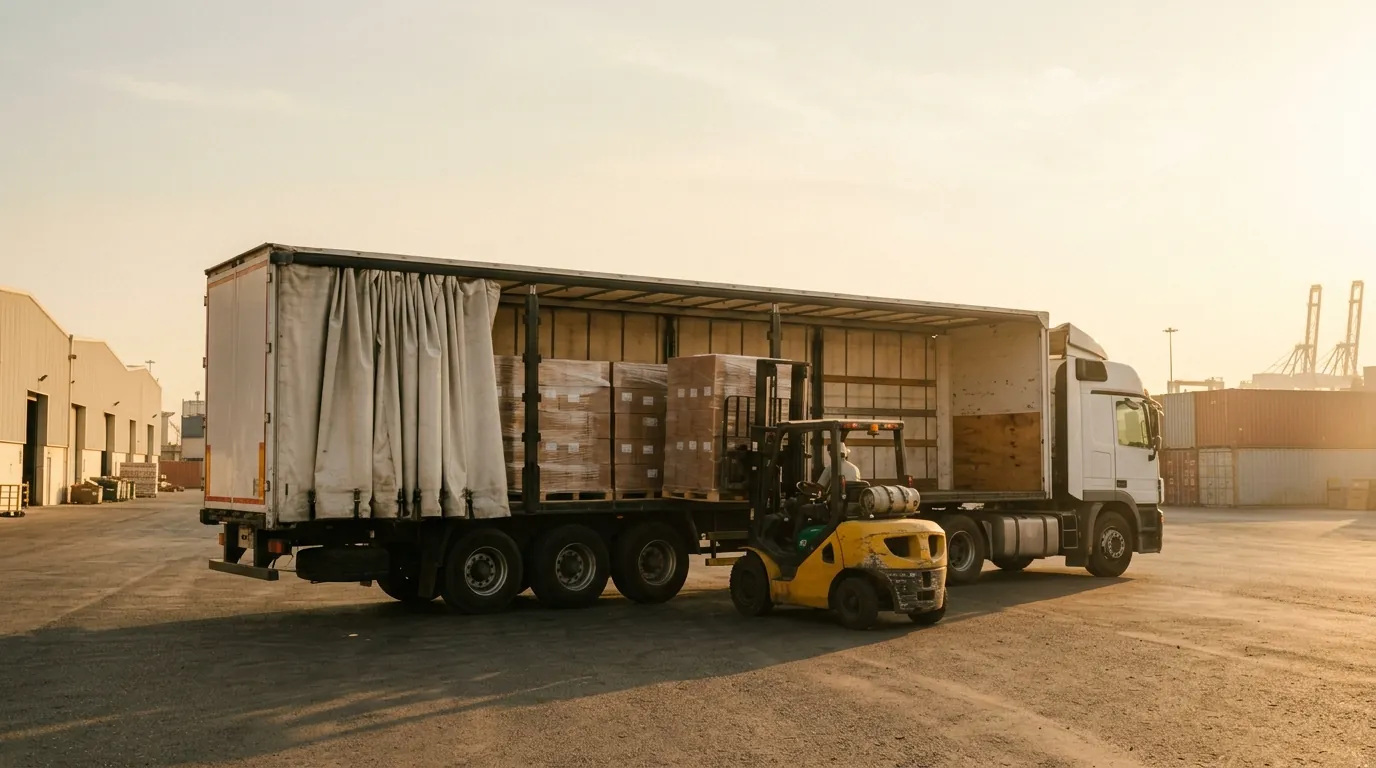
It is a very common trailer on GCC road freight for palletised and general cargo: cartons, bagged goods, tiles, appliances and furniture. It also suits a part load, because each customer's pallets can come off at their own stop without moving everyone else's. The curtain keeps the weather out, but it is still fabric. For cargo that must sit behind solid walls, book a box.
Box trailer: closed, locked and weatherproof
A box trailer, also called a closed body or dry van, has solid walls, a solid roof and doors at the back. Dust stays out, water stays out, and the doors can be locked and sealed. Book a box for goods that must stay clean, dry and out of sight: retail and online shop stock, electronics, clothing, documents, and household goods for a family moving between emirates or across the border.
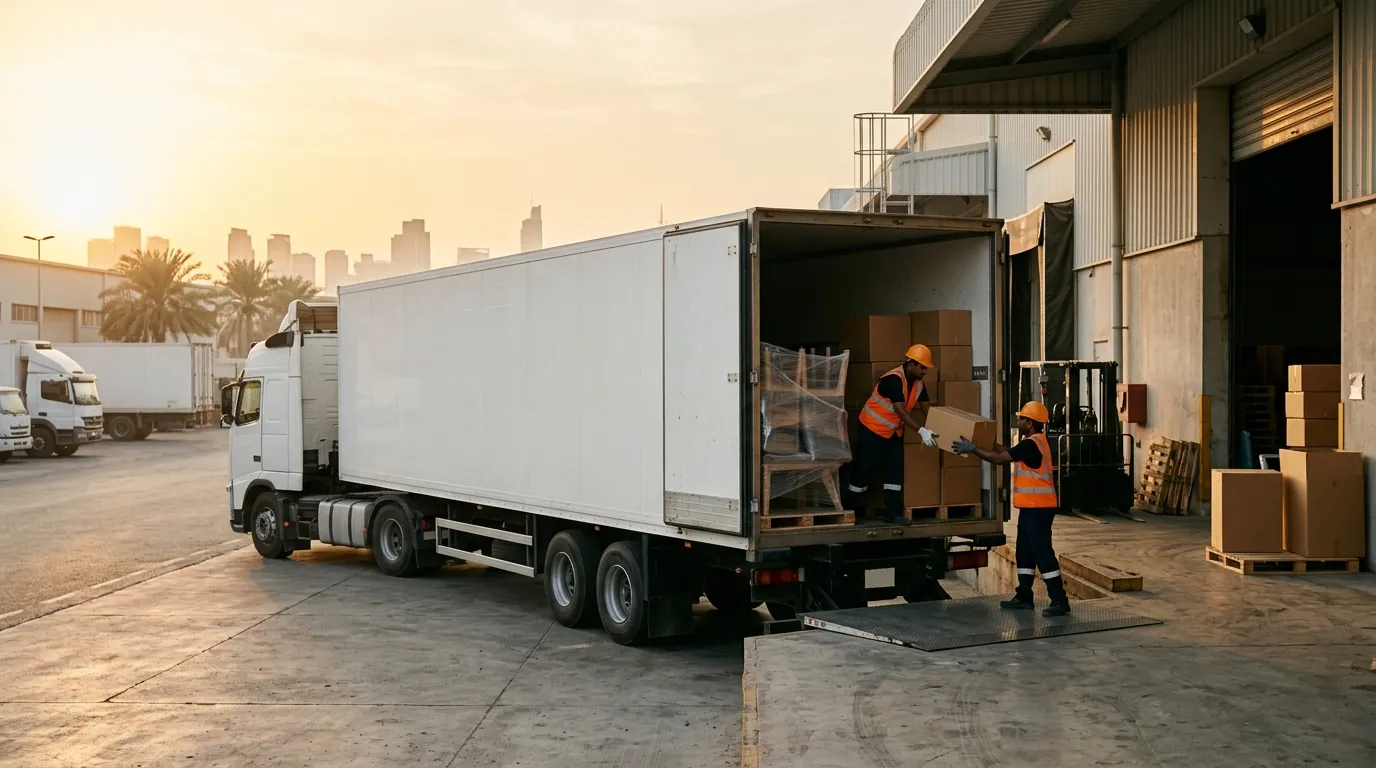
There are two trade-offs. Everything goes in through the rear doors, so heavy pallets need a loading dock or a forklift, and the last pallet in is the first one out. And a closed box gets very hot inside in a Gulf summer. Anything that can melt, spoil or lose its strength in the heat belongs in a reefer, even if it does not need to be cold.
Side loader trailer: lifts a container on and off without a crane
A side loader, also called a side lifter, is a container trailer with two hydraulic cranes built onto it, one at each end. The cranes reach out, lift the container off the ground and set it on the trailer, then do the same in reverse at the delivery address. No crane is needed at either end, and neither is a reach stacker, the giant forklift that ports use to move containers.
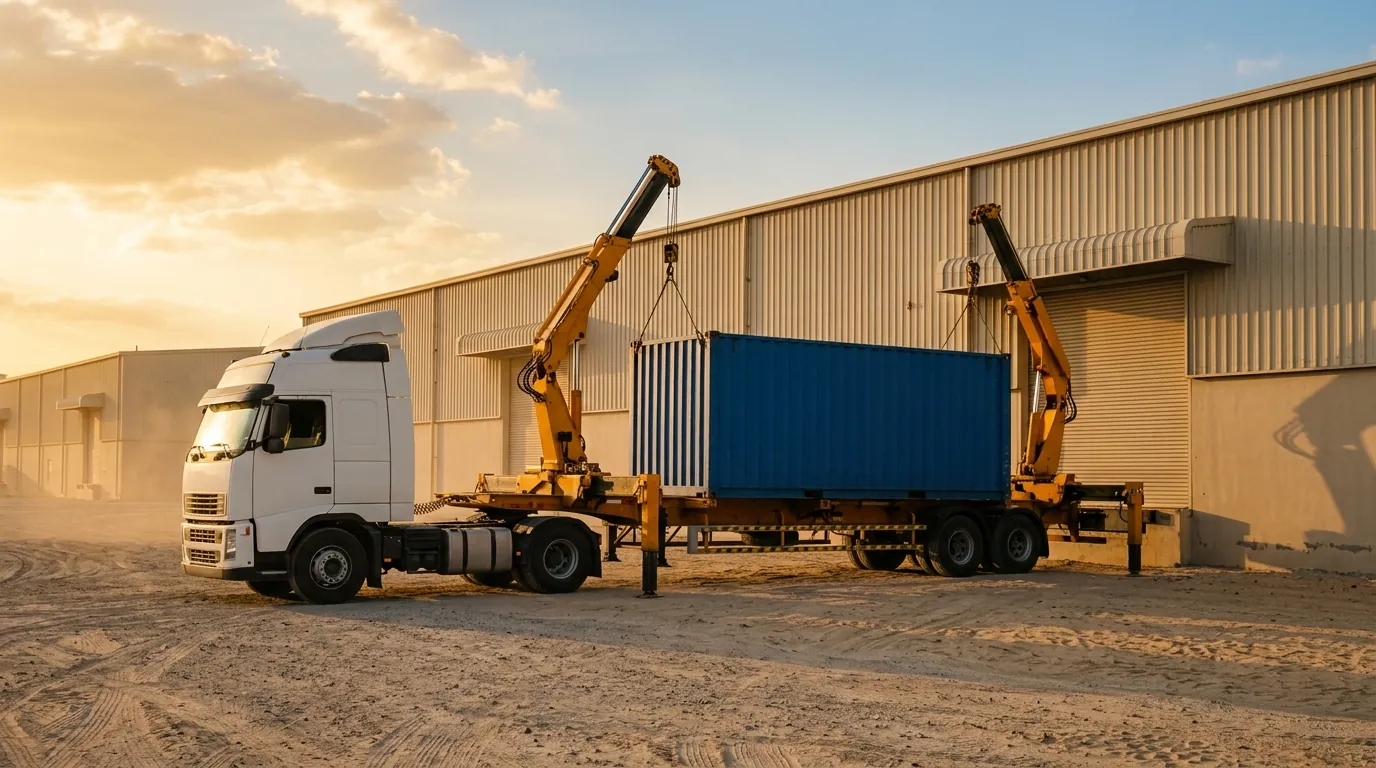
That changes how a delivery works. The container can be set down on the ground at your warehouse, farm or site and left there while you unload it at your own pace. When it is empty, the side loader comes back, lifts it on and returns it. It handles 20ft and 40ft containers, and it is the usual answer for a delivery out of Jebel Ali to a place with no lifting gear of its own.
Lowbed trailer: heavy equipment and tall machinery
A lowbed trailer, also written low bed or called a low loader, has a deck that drops down close to the road between the truck and the rear wheels. The low deck buys height. A tall machine that would be too high on a flatbed can travel on a lowbed and still pass under bridges and signs.
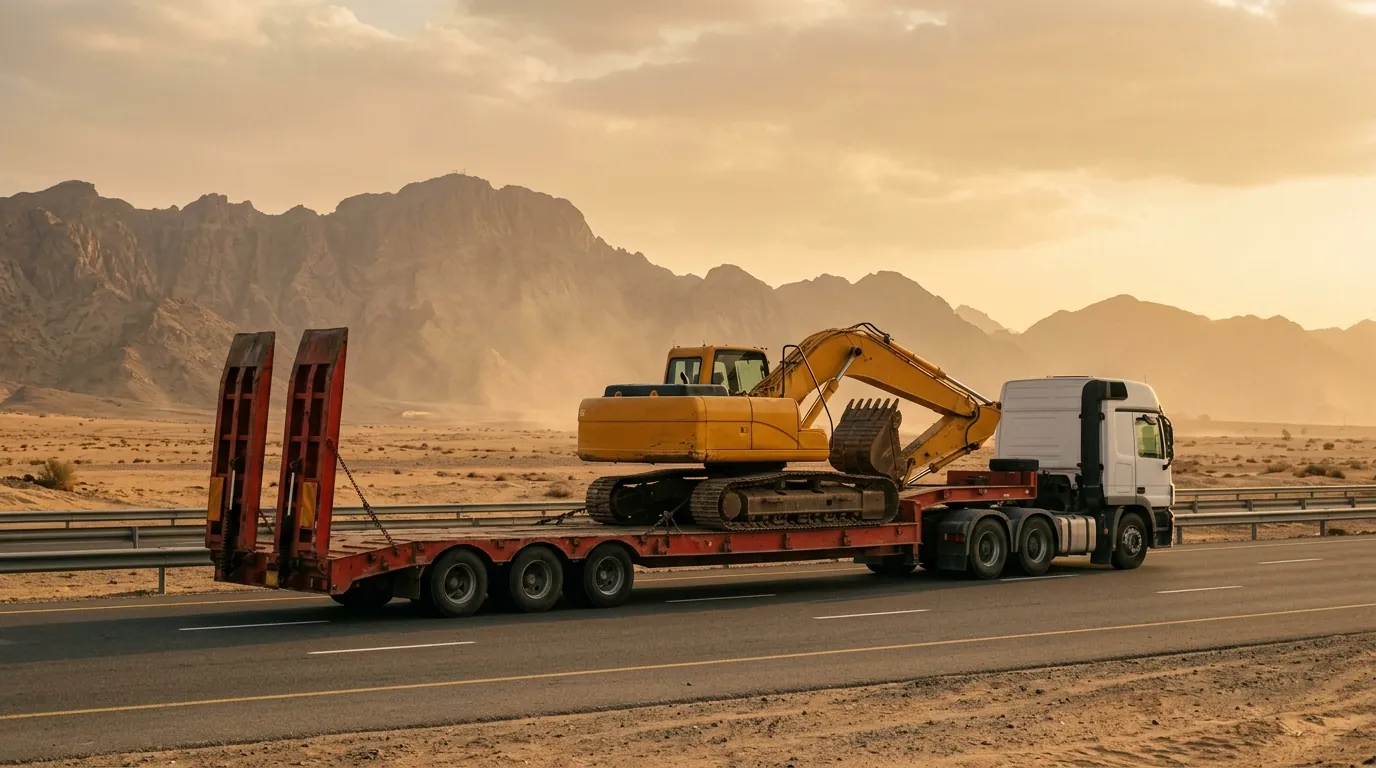
Use it for heavy equipment transport: excavators, bulldozers, wheel loaders, mobile cranes, generators, transformers, boilers and industrial plant. Many lowbeds have ramps at the back, so tracked and wheeled machines drive straight on. More axles spread more weight, so the trailer is chosen from the weight and size of the piece. When a load is too wide, too long or too heavy for normal road limits, the move is planned as project cargo, with the route and permits agreed first.
Reefer trailer: chilled and frozen cargo
A reefer trailer is an insulated box with a refrigeration unit on the front wall. It holds the temperature you set, chilled for fresh produce or frozen for meat and fish, for the whole journey. In the UAE you will also hear it called a reefer truck, a chiller truck, a freezer truck or a refrigerated truck.
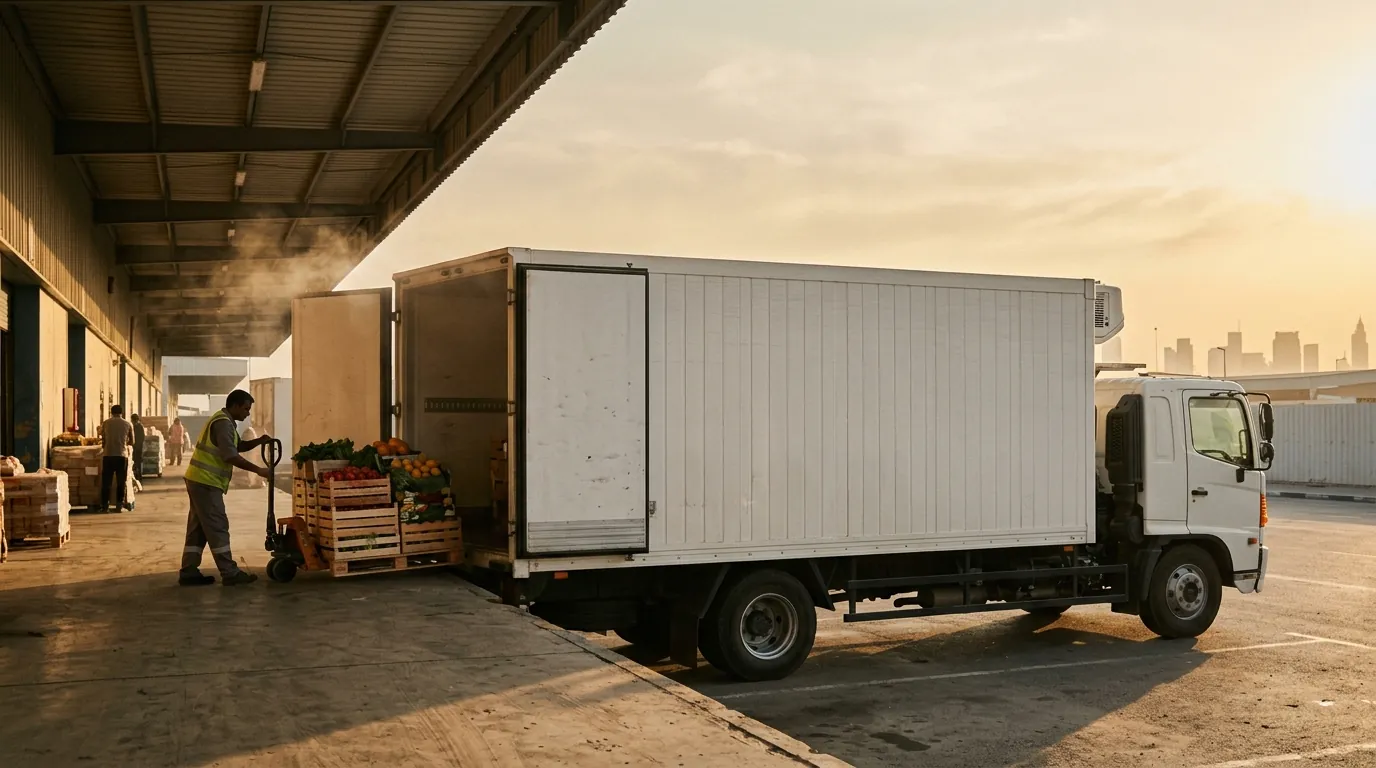
Book a reefer for food, fruit and vegetables, dairy, meat, seafood, flowers, chocolate, and medicines and vaccines that need a controlled temperature. A reefer keeps cargo cold. It does not make warm cargo cold. Load the goods at the right temperature, from a cold store if you can, and agree the temperature setting in writing before the truck arrives. For medicines, ask for the temperature record from the unit for the whole trip.
Container chassis or skeleton trailer: from the port to your door
A container chassis is a steel frame with locks at the corners, called twistlocks, that clamp a shipping container in place. It has no floor, which is why in the UAE it is usually called a skeleton trailer or skeletal trailer. A port crane or a reach stacker puts the container on, and the trailer carries it between the port, the container depot and your warehouse.
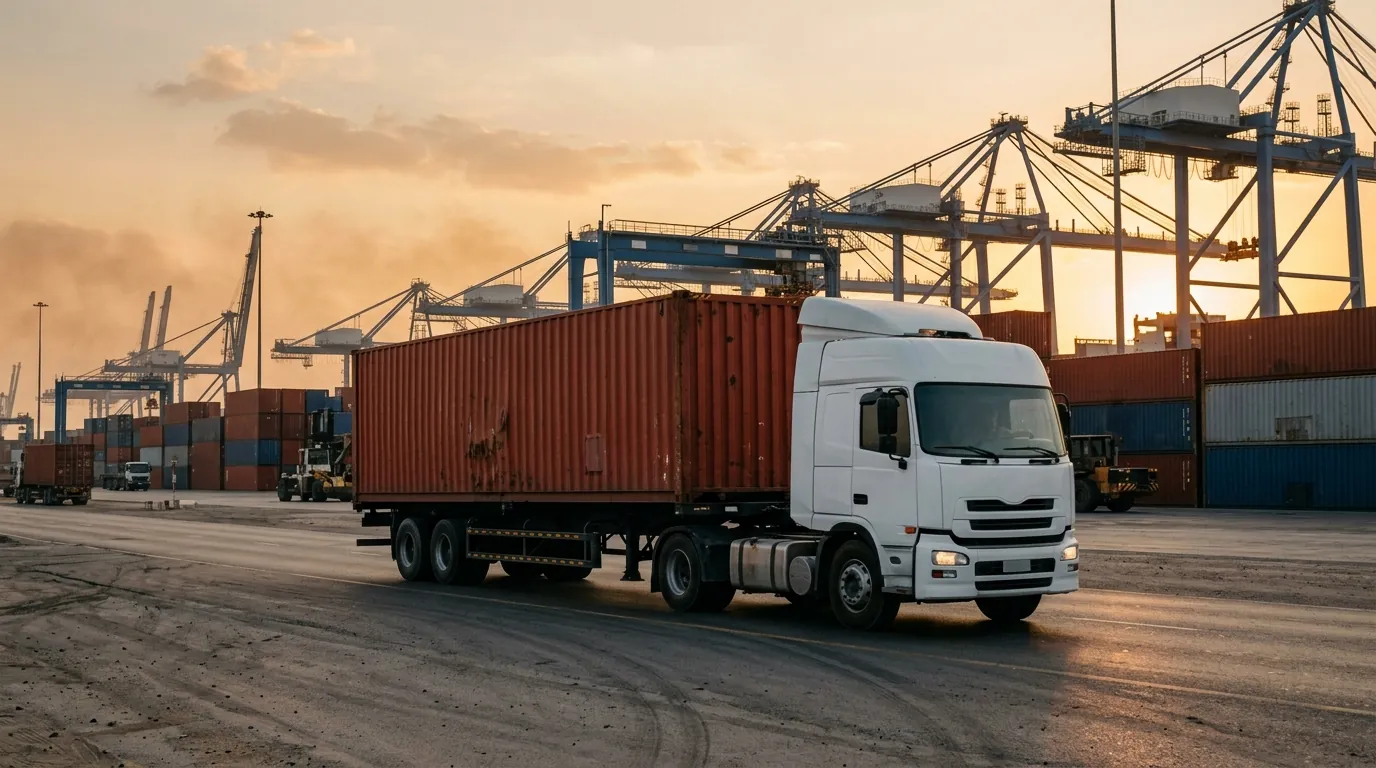
This is the standard way a sea container makes its road leg out of Jebel Ali and Khalifa Port. Unlike a side loader, a chassis cannot put the box on the ground. The container is unloaded while it sits on the trailer, at a loading dock or with a forklift, and the truck waits until it is done. If you need the container left with you for a few days, book a side loader instead. When we handle the container shipping, the road leg is booked with the sea leg, so the truck is ready when the box is released.
Local transport in the UAE: which trailer for which job
For local transport inside the UAE, the distances are short, so the delivery address decides more than the distance does. Does the site have a loading dock, a forklift, or level ground for a side loader? Can a full-size trailer get down the street at all? Tell us the access and we plan the delivery around it before the truck sets off. We run container and trailer transport across all seven emirates, including the free zones, where we arrange the gate access for the truck.
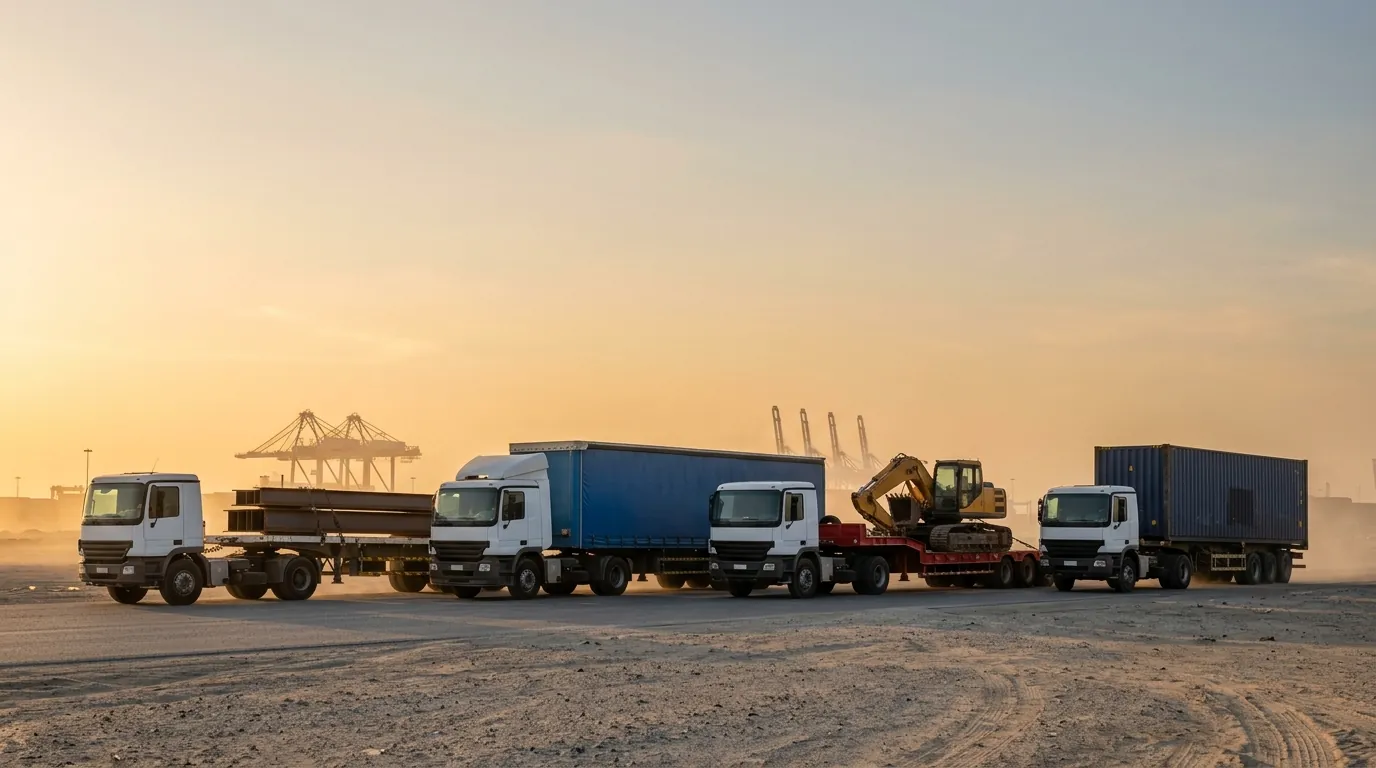
- Dubai: Jebel Ali Port and JAFZA, Port Rashid, Dubai South, Dubai Investments Park, Al Quoz, Al Qusais and Ras Al Khor
- Abu Dhabi: Khalifa Port and KIZAD, Mussafah, ICAD, Al Ain, and the Al Dhafra region out to Ruwais
- Sharjah: the industrial areas, Hamriyah Free Zone, SAIF Zone, Port Khalid, and Khor Fakkan on the east coast
- Ajman: Ajman Free Zone and the port and industrial area around it
- Umm Al Quwain: the free trade zone and the industrial areas
- Ras Al Khaimah: RAKEZ and the industrial zones, plus quarry and construction sites inland
- Fujairah: the Port of Fujairah, the free zone, Dibba, and the east coast down to Kalba
Plan around the clock as well as the map. Dubai, Sharjah and Abu Dhabi each keep heavy trucks off some main roads at set times, and the hours change often. Our page on truck ban timings in the UAE links to the official notices for each emirate. A truck booked into a ban window simply waits. We set the collection time around the rules in force that week, and hold cargo in warehousing in Dubai when a delivery date has to move.
GCC road freight: which trailers cross the border
For road freight across the GCC, a longer run changes the choice. Cargo that rides open on a flatbed for an afternoon in Sharjah can spend days under the Saudi sun on the way to Riyadh, so covered trailers earn their place on the long lanes, and anything heat-sensitive goes in a reefer. The truck that loads in Dubai delivers to the door in Riyadh, Muscat or Kuwait City, with no port at either end. The border is what takes the time, so the papers are ready before the truck loads and the customs clearance is handled as part of the run, not left with the driver.
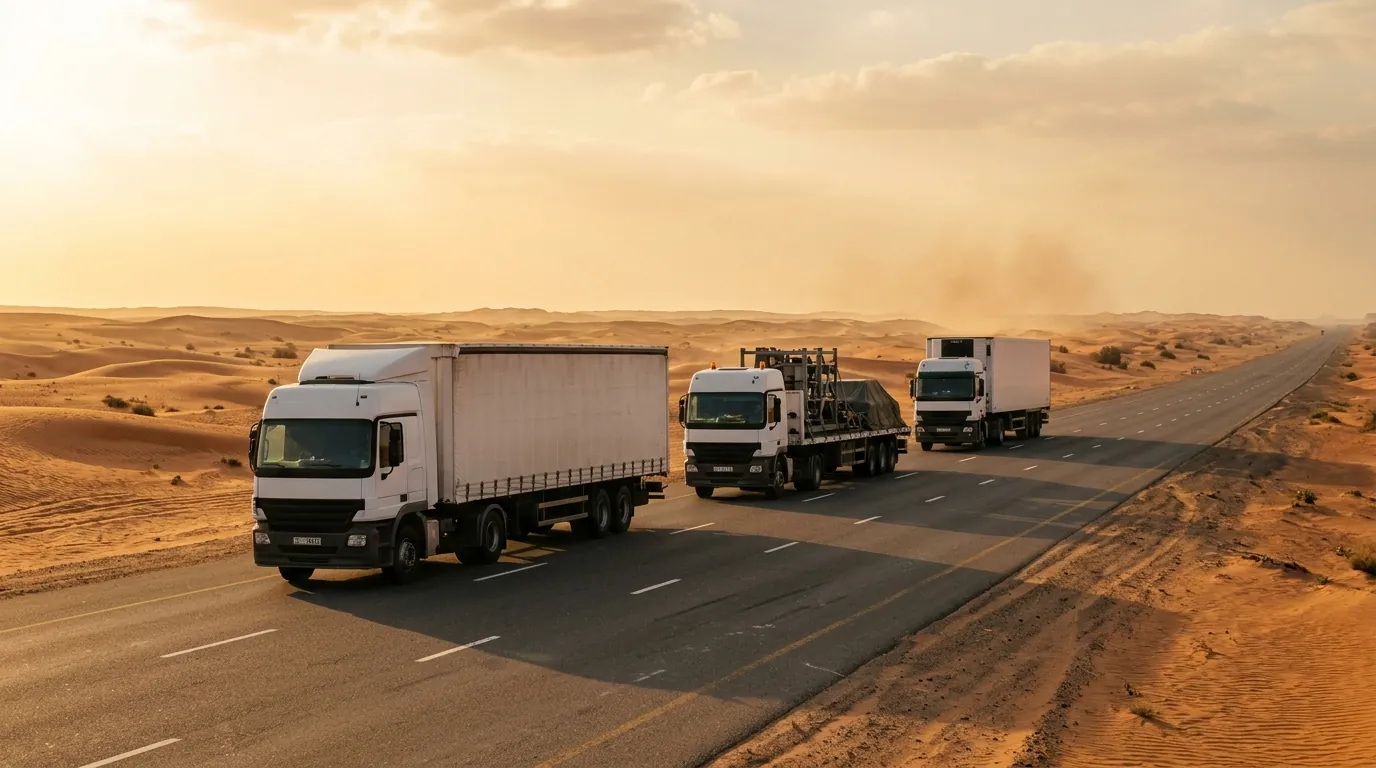
- Dubai to Saudi Arabia: out of the UAE at Al Ghuwaifat and into Saudi Arabia at Al Batha, then on to Dammam, Al Khobar, Jubail, Riyadh, Jeddah and beyond. Regulated products need SABER conformity before the truck loads, and our Saudi border guide walks through the crossing
- Dubai to Oman: through Hatta and Al Wajajah for Muscat and Nizwa, or Khatmat Malaha for Sohar and the Batinah coast, with Salalah and Duqm further south
- Dubai to Kuwait: across Saudi Arabia in transit, then into Kuwait at Nuwaiseeb for Kuwait City
- Dubai to Qatar: across Saudi Arabia in transit, then from Salwa into Qatar at Abu Samra for Doha
- Dubai to Bahrain: across eastern Saudi Arabia and over the King Fahd Causeway to Manama and Muharraq
Sea containers need one extra check. Each shipping line decides whether its containers may leave the UAE by road, and the answer is not always yes. Where the box cannot cross, the cargo is moved into a trailer in Dubai first. Our cross stuffing team does that under customs supervision, and we prepare the paperwork for the onward trip. The same trailers run past the GCC on some lanes too, such as Dubai to Iraq by road through Safwan.
How long does a truck take from Dubai to the GCC?
A truck from Dubai reaches Dammam, Sohar, Muscat or Bahrain in about 1 to 3 days, Riyadh in 2 to 4, Doha in 2 to 5, Jeddah in 3 to 5 and Kuwait City in 4 to 6. These are the usual door-to-door road ranges from our country pages, researched in August 2026 from published road transit times and operators running each lane.
| Dubai to | Usual road transit | Border crossing |
|---|---|---|
| Dammam and Al Khobar, Saudi Arabia | 1 to 3 days | Al Ghuwaifat into Al Batha |
| Riyadh, Saudi Arabia | 2 to 4 days | Al Ghuwaifat into Al Batha |
| Jeddah, Saudi Arabia | 3 to 5 days | Al Ghuwaifat into Al Batha, then across the country |
| Sohar, Oman | 1 to 2 days | Khatmat Malaha |
| Muscat, Oman | 1 to 3 days | Hatta into Al Wajajah |
| Manama, Bahrain | 1 to 3 days | Al Batha, then the King Fahd Causeway |
| Doha, Qatar | 2 to 5 days | Al Batha, then Salwa into Abu Samra |
| Kuwait City, Kuwait | 4 to 6 days | Al Batha, then Nuwaiseeb |
The drive is the predictable part. Where a truck lands inside its range is decided at the border: a truck that arrives with a complete file crosses in hours, and one missing a certificate can wait a day or more. Inside the UAE the distances are short, so timing is set more by loading slots and truck ban hours than by the drive.
How to choose the right trailer for your cargo
Answer these questions and the trailer usually picks itself.
- What is it, and how is it packed? Pallets, loose cartons, long lengths, one machine or a sealed container
- How heavy is the heaviest piece, and how heavy is the whole load?
- How big is it? Length, width and height, as packed, for every piece
- What does it need protecting from? Rain, dust, theft, heat or cold
- How will it be loaded and unloaded? A dock, a forklift, a crane, or nothing at all
- Is there room at the delivery site for the truck to turn, or for a side loader to set a container down?
- Is it a full load or a part load? A full truck load (FTL) has the trailer to itself; a part load (LTL) shares it
- Is it crossing a border? Then the documents and any product certificate come first
If two answers point at different trailers, the cargo wins over the price. A cheaper flatbed is not cheaper if the load arrives wet. If you are still weighing road against sea or air, our comparison of shipping methods from Dubai sets them side by side.
What moves the price of a truck and trailer
A road freight price is built from more than the drive. Before looking at any figure, it helps to know what the total is made of, so two quotes can be compared line by line.
| Cost line | What it covers | Where it matters most |
|---|---|---|
| Trailer type | The body booked for the job | Lowbeds, side loaders and reefers are usually priced above a flatbed or curtain-side |
| Distance and route | The drive and the fuel | Long GCC runs, and routes that must avoid height or weight limits |
| Border and customs | Export and import declarations, and transit papers | Every run to Saudi Arabia, Oman, Kuwait, Qatar and Bahrain |
| Waiting time | Hours the truck stands while loading, unloading or at the border | Box and chassis loads with no dock, and border files that are not complete |
| Permits | Approval for an oversized load | Lowbed moves beyond normal road limits |
| Container return | Taking the empty container back to the depot the line names | Chassis and side loader moves, before the free days run out |
| Temperature | Running the fridge unit for the whole trip | Reefer loads, and long runs in summer |
Ask every company to quote the same scope, with the trailer type named on the quote. A low price on the wrong trailer turns into the most expensive quote on the table.
How much does a truck from Dubai cost? Published estimates
As a rough guide, a full 40ft trailer from Dubai is published at about USD 1,100 to 2,000 to Dammam, USD 1,400 to 2,600 to Riyadh and USD 2,200 to 3,800 to Jeddah, and a container truck inside the UAE from about AED 600. These are estimates published by other UAE shipping and customs companies, checked in October 2026, not our prices, so ask us for a current price on your load.
| Route and load | Published estimate | What it covers |
|---|---|---|
| Jebel Ali to Ras Al Khor, Dubai: 20ft or 40ft high cube container | AED 599 | Container trucking with up to 24 hours to load or unload |
| Jebel Ali to Fujairah: 40ft high cube container | AED 2,299 to 2,599 | Container trucking across the country to the east coast |
| Dubai to Dammam, Al Khobar or Jubail: full 40ft trailer | USD 1,100 to 2,000 (about AED 4,000 to 7,300) | Freight only |
| Dubai to Riyadh: full 40ft trailer | USD 1,400 to 2,600 (about AED 5,100 to 9,500) | Freight only |
| Dubai to Jeddah: full 40ft trailer | USD 2,200 to 3,800 (about AED 8,100 to 14,000) | Freight only |
| Dubai to Saudi Arabia: part load | USD 90 to 180 per cubic metre (about AED 330 to 660) | Shared trailer, priced by volume |
| Dubai to Riyadh: part load of 100 to 2,000 kg | AED 800 to 3,500 per shipment | Shared trailer, priced by weight and urgency |
| Dubai to Oman, Kuwait, Qatar or Bahrain | Get a quote | Priced on your load, trailer and route |
The Saudi figures leave out import duty, VAT, conformity certificates such as SABER, and unloading, which the receiver pays on top. A lowbed, reefer or side loader usually costs more than the plain trailer these figures assume. Treat every number here as an estimate for scale, then send us the weight, size, trailer type and both addresses for a current price.
This guide explains official rules in plain words. The authority's own notice is always the final word, and we confirm the rules for your shipment when you book.
Frequently asked questions
What is a trailer head or prime mover?
The truck at the front that pulls the trailer, also called a tractor unit. The two are separate pieces of equipment, so one head can drop a loaded trailer and hook up to another. When you book a full truck load, the head, the trailer and the driver come together.
What is the difference between a reefer truck and a reefer container?
A reefer truck, or reefer trailer, has its own fridge unit and runs on the road from door to door. A reefer container is a refrigerated box that travels by sea. When it comes off the ship at Jebel Ali it rides on a container chassis, and because its fridge needs power, a generator set, called a genset, is clipped on for the road leg. Tell us if your cargo arrives in a reefer container, so the right chassis and genset are booked.
Which trailer do I need to move a car by road?
A car carrier trailer takes several running cars on two decks. A single car can travel on a flatbed or inside a box trailer, and a closed box is the better choice for a classic or high-value car. For a car going to Saudi Arabia, check the rules on age and condition before it loads. For another GCC country, ask us and we check the rules for your car. Our car shipping team handles the export paperwork.
How should cargo be packed for a truck trip?
Shrink-wrap and strap cartons onto pallets so each pallet moves as one block. Put heavy items at the bottom, and spread the weight evenly along the trailer rather than piling it at one end. On a flatbed, put corner and edge protectors under the straps so they do not cut into the goods. Label every piece with the delivery address, and send us the packing list so the driver and customs can count what is on board.
Can one truck carry two 20ft containers?
Often, yes. A 40ft container chassis can normally take two 20ft containers at once, as long as the combined weight stays within the road limit. Two fully loaded 20ft boxes can go over it, so we check the weights first. It only makes sense when both containers are going to the same place, or to two stops on the same route.
What does a side loader need at the delivery site?
Space and firm ground. The trailer parks beside the spot where the container will sit, so it needs clear, level ground next to it, room for the support legs to go down, and no cables or roofs overhead for the cranes to hit. Soft sand or a sloping yard is a problem. Send us photos of the site and we will tell you whether it works.
How long can a container stay on the ground after a side loader drops it?
As long as the shipping line's free days allow. The line gives a set number of days to return the empty container, and charges a daily fee, called detention, after that. Unload promptly and book the collection before the free days run out. We tell you the free time when we book the delivery.
Can a reefer trailer carry chilled and frozen goods together?
A standard reefer holds one temperature for the whole box, so chilled and frozen goods normally travel apart. Some trailers have a divider and two temperature zones, which can take a mixed load. Give us both temperatures when you ask for a quote and we will confirm whether one truck can do it.
Do I need a permit to move heavy equipment by road in the UAE?
Only when the load is oversized. A machine that fits within normal road limits on a lowbed moves like any other truck. An oversized load needs a special permit before it moves. We check what your load needs from its size and weight before we quote, and arrange the permit as part of the move.
Which trailers can be booked as a part load?
Mostly curtain-side and box trailers. Reefer part loads exist on some routes, depending on the temperature. Lowbeds, side loaders and container chassis are booked whole, because the trailer is built around one piece or one container.
Is my cargo insured while it is on the truck?
Not fully, unless you insure it. Goods in transit insurance covers the declared value and is arranged separately. It is worth having for electronics, machinery and anything hard to replace.
Can you track a truck from Dubai to the GCC?
Yes. We confirm when the truck loads, when it clears the UAE border, when it enters the destination country and when it delivers, against your booking reference. If a truck is held at a border we tell you why and what is needed, rather than waiting to be asked.
Why does a truck to Kuwait take longer than one to Bahrain?
Because it crosses two borders and the whole length of eastern Saudi Arabia on the way. A truck for Kuwait clears out of the UAE at Al Ghuwaifat, runs through Saudi Arabia in transit past Dammam and Jubail, and clears in again at Nuwaiseeb. Bahrain turns off much earlier, at the King Fahd Causeway near Al Khobar, so it is a shorter drive with less time in transit.
Official and authoritative references
- Dubai Media Office: truck movement restrictions across Dubai from 1 October 2026
- Abu Dhabi Mobility: restricted movement hours for heavy vehicles
- Sharjah Roads and Transport Authority: extended truck restriction hours, March 2026
- DP World: Jebel Ali Port
Not sure which trailer your cargo needs?
Send the weight, the size and both addresses, and we will book the right truck in the UAE or across the GCC.