
Shipping from Dubai
to Jordan.
We move cargo to Jordan from Dubai every week, by sea, by road and by air. We ship business and personal cargo. Send a few boxes, a pallet, a full container, or a whole house move. We collect anywhere in the UAE, do the customs paperwork at both ends, and deliver to your address in Jordan.
Overview
Sea, road and air freight
to Jordan.
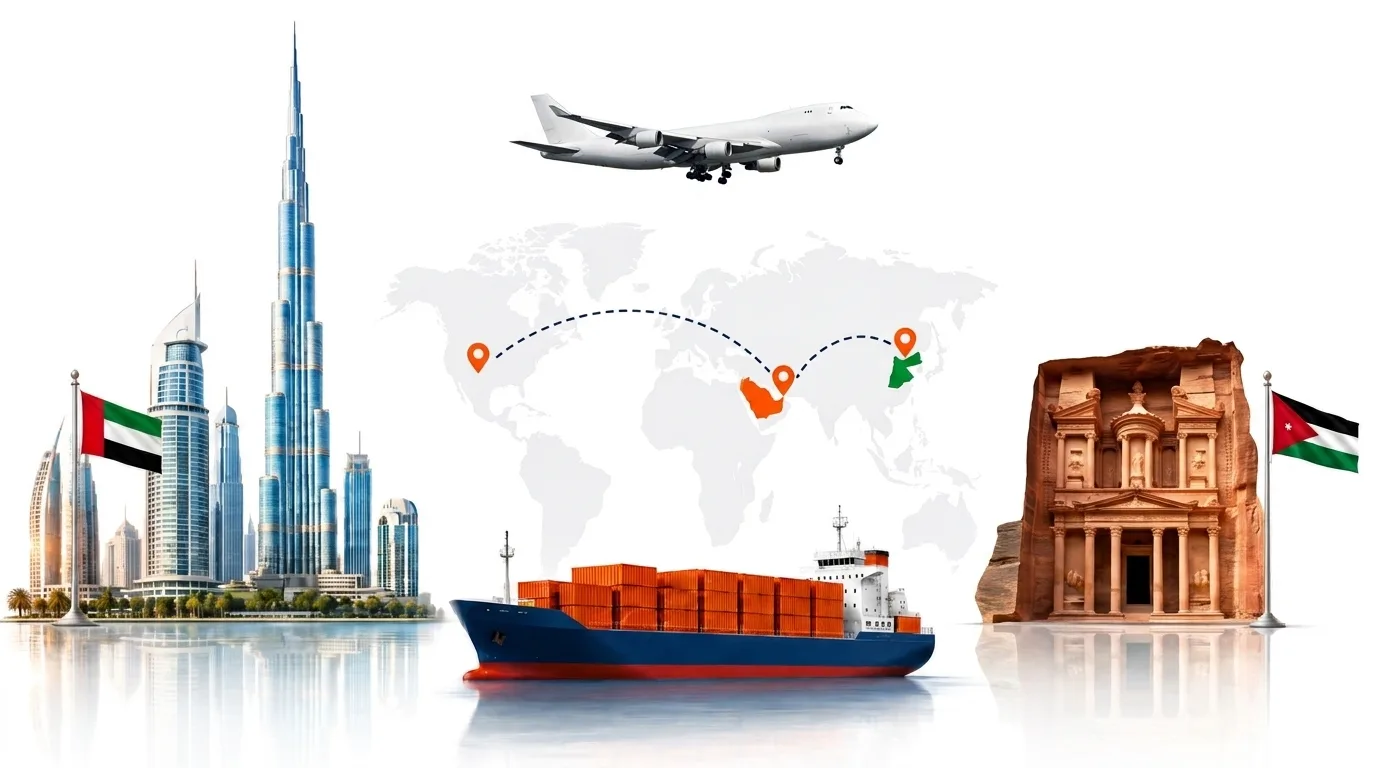
Shipping from Dubai to Jordan takes about 5 to 12 days by sea, 4 to 8 days by road, and 1 to 4 days by air. Aqaba is Jordan's only sea port, on the Red Sea, and almost all sea cargo comes through it. Road runs across Saudi Arabia and delivers to the door. Air reaches Amman and Aqaba. We deliver everywhere, including Amman, Zarqa, Irbid, Aqaba, Madaba, Mafraq, Karak and Ma'an. We move machinery, building materials, furniture, electronics, food and household goods. Navo Shipping handles the sea freight, land freight, air freight and customs clearance on the Dubai to Jordan route, door to door. Tell us what you are sending, how heavy it is, and where it is going, and we will tell you which way is cheaper.
Ports and gateways
Sea ports and airports
we ship to from Dubai.
Every bill of lading carries two ports: where the cargo loads, and where it discharges. We load at Jebel Ali or another UAE port. Sea cargo to Jordan discharges at Aqaba, the only sea port in the country, so there is no discharge port to choose. What is worth choosing is the mode, and where the cargo clears.
POLPort of loading
We collect anywhere in the UAE, free zones included, and load at whichever of these eight suits the cargo.
- Jebel AliAEJEA
- Port RashidAEPRA
- Khalifa PortAEKHL
- Zayed PortAEAUH
- Port KhalidAESHJ
- Khor FakkanAEKLF
- Port of FujairahAEFJR
- Ajman PortAEAJM
PODPort of discharge
The right one is whichever leaves the shortest inland leg to your delivery address. On a long lane that leg is a shipment in its own right, so it is planned rather than assumed.
- AqabaJOAQJSea port · Gulf of Aqaba, Red SeaThe whole country. Jordan’s only sea port
How cargo reaches Aqaba
Shipping from Dubai to Aqaba runs down the Gulf and up the Red Sea without entering the Suez Canal, roughly 5 to 12 days port to port, direct on some strings and relayed on others. It is the only sea gateway in the country, so there is no port decision to make, only the decision about where the cargo clears. Aqaba sits inside a special economic zone with its own customs authority, so goods stopping in the zone clear once and goods going on to Amman clear again at the zone boundary. Sea freight is priced per container on FCL and per cubic metre on LCL. Get a rate for Aqaba - Queen Alia International, AmmanAMMAirportAmman, Zarqa, Irbid and the whole north
How cargo reaches Queen Alia International, Amman
Air freight from Dubai to Queen Alia International, Amman can fly nonstop from Dubai to the cargo facilities south of Amman. Air freight usually takes around 1 to 2 days, depending on the flight, with clearance adding time. Queen Alia serves Amman and Zarqa; Aqaba airport is closer to southern deliveries. The quote combines weight or space used, airport handling, customs clearance and delivery. Get a rate for Queen Alia International, Amman - King Hussein International, AqabaAQJAirportAqaba and the special economic zone
How cargo reaches King Hussein International, Aqaba
Air freight from Dubai to King Hussein International, Aqaba needs a confirmed cargo connection through Amman or an approved charter into Aqaba. Times vary from flight to flight, so we confirm the days when we quote. Aqaba airport suits the southern economic zone; Queen Alia suits Amman and the north. The quote combines weight or space used, airport handling, customs clearance and delivery. Get a rate for King Hussein International, Aqaba - Marka, AmmanADJAirportAmman, for regional and charter traffic
How cargo reaches Marka, Amman
Air freight from Dubai to Marka, Amman requires an approved charter arrival at Amman Civil Airport. Times vary from flight to flight, so we confirm the days when we quote. Marka suits a specifically accepted charter; Queen Alia is the alternative for scheduled international cargo. The quote combines weight or space used, airport handling, customs clearance and delivery. Get a rate for Marka, Amman - Amman Customs inland terminalDry portAmman and Zarqa. National clearance for cargo trucked up from Aqaba
How cargo reaches Amman Customs inland terminal
Shipping from Dubai to Amman Customs inland terminal travels by sea to Aqaba and then by truck under customs control to inland clearance. Times vary from ship to ship, so we confirm the days when we quote. Amman Customs brings clearance near Amman and Zarqa; Aqaba clearance suits cargo staying in the south. The quote combines sea freight, bonded trucking, inland handling, customs clearance and local delivery. Get a rate for Amman Customs inland terminal - Durra land portLand borderThe Saudi border near Aqaba, on the Red Sea coast road
How cargo reaches Durra land port
Shipping from Dubai to Durra land port travels across Saudi Arabia to the Haql to Aqaba coastal crossing. Border queues and checks vary, so we confirm delivery days when we quote. Durra suits Aqaba and the southern coast; Al Omari suits the eastern approach to Amman. The quote combines trucking, transit paperwork, border handling, customs clearance and delivery. Get a rate for Durra land port - Al Omari land portLand borderThe Saudi border on the eastern desert road, the shortest route to Amman
How cargo reaches Al Omari land port
Shipping from Dubai to Al Omari land port travels by truck through Al Batha and Saudi Arabia, entering Jordan opposite Al Haditha. Border queues and checks vary, so we confirm delivery days when we quote. Al Omari suits Amman and Zarqa; Durra is the coastal alternative near Aqaba. The quote combines trucking, transit paperwork, border handling, customs clearance and delivery. Get a rate for Al Omari land port - Jaber land portLand borderThe Syria border opposite Nasib
How cargo reaches Jaber land port
Shipping from Dubai to Jaber land port travels through Saudi Arabia and Jordan to the crossing facing Nasib in Syria. Border queues and checks vary, so we confirm delivery days when we quote. Jaber serves onward Syria traffic; Al Omari is the Saudi entry for cargo staying in Jordan. The quote combines trucking, transit paperwork, border transfer where required and customs clearance. Get a rate for Jaber land port - Karameh land portLand borderThe Iraq border on the Baghdad road, opposite Trebil
How cargo reaches Karameh land port
Shipping from Dubai to Karameh land port travels through Saudi Arabia and eastern Jordan before reaching Trebil on the Iraqi side. Border queues and checks vary, so we confirm delivery days when we quote. Karameh serves the Baghdad corridor; Jaber serves onward Syria traffic. The quote combines trucking, transit paperwork, border handling, customs clearance and delivery. Get a rate for Karameh land port - King Hussein BridgeLand borderThe West Bank crossing on the Jordan river
How cargo reaches King Hussein Bridge
Shipping from Dubai to King Hussein Bridge travels by truck through Saudi Arabia and Jordan to the Allenby cargo terminal. Border queues and checks vary, so we confirm delivery days when we quote. King Hussein Bridge serves West Bank deliveries; Sheikh Hussein serves northern Israel under separate arrangements. The quote combines trucking, border cargo transfer, inspections, customs clearance and final delivery. Get a rate for King Hussein Bridge
- AqabaJOAQJSea port · Gulf of Aqaba, Red SeaThe whole country. Jordan’s only sea port
Before you ship
Import rules
for Jordan.
There is one thing about Jordan worth knowing before you book. Aqaba is inside a special economic zone with its own customs rules. If your goods are staying in Aqaba, they clear once and that is it. If they are going to Amman, Zarqa, Irbid or anywhere else in the country, they clear a second time when they leave the zone, at the national rates. That is normal and we handle it, but it changes the cost and the timing, so we need your delivery address rather than just the port. Some products also need a conformity certificate, which we arrange in Dubai. Tell us where the goods are going and what they are, and we will set it all out.

Documentation
Documents you need
for Jordan.
These 7 cover most shipments to Jordan. The exact list depends on the commodity and its HS code, so send us both and we confirm what applies before the cargo is booked.
- 01Invoice showing what you paid for the goods
- 02Packing list showing what is inside
- 03Certificate of origin showing where the goods were made
- 04Bill of lading, air waybill or road manifest
- 05Dubai export paper, which we do for you
- 06Conformity certificate, if your product needs one
- 07The Jordanian buyer tax and importer number
Get the paperwork right in Dubai and clearance at destination is routine. Fixing a document after arrival is slow, and storage accrues the whole time it takes.

How it works
Dubai to Jordan
shipping, step by step.
Send the cargo details: what it is, where it is going, rough weight and dimensions. We come back with the routes that suit it, sea against road against air, and a written rate with a validity date on it. You pick one, we book it, and one coordinator stays with the shipment until it is delivered in Jordan.
- 01
Send the details
Tell us what you are sending, how heavy it is, how big it is, and where in Jordan it goes.
- 02
Get a price
We send you a price in writing, with every charge shown. No surprises later.
- 03
We book and clear
We collect the goods, load them, and handle both the Aqaba and the national clearance if your goods go inland.
- 04
We deliver
We track the shipment and keep you updated all the way, then bring the goods to your door.
Questions
Cargo to Jordan
questions, answered.
The 15 we are asked most on the Dubai to Jordan route. If yours is not here, send it with the commodity and we will answer it directly.
Do you offer movers and packers for a house move from Dubai to Jordan?
Yes. Our movers and packers do the packing, wrapping and listing in Dubai, then we ship your furniture and household goods in a full container, or share one if you have less to send. The item by item list matters, because customs clear personal effects against it. Fuel, gas cylinders, paint, aerosols and loose batteries cannot travel, and we give you the full list before packing day.
How long does shipping from Dubai to Jordan take?
About 5 to 12 days by sea to Aqaba, 4 to 8 days by road, and 1 to 4 days by air. Add time for customs and the road leg up to Amman if that is where the goods are going. We give you a date in writing when we quote.
How much does shipping from Dubai to Jordan cost?
It depends on what you send, how big it is, and where in Jordan it is going. We do not publish prices because every shipment is different. Sea freight to Jordan is priced per container when you fill one, and per cubic metre when you share one. Air freight to Jordan is priced on weight or size, whichever is greater. Send us the details and we send you a price in writing, usually the same day.
Which cities in Jordan do you deliver to?
All of them. Amman, Zarqa, Irbid, Aqaba, Madaba, Mafraq, Karak, Tafilah and Maan. Just give us the address and we bring it to the door.
Which Jordanian port do you ship to?
Aqaba, on the Red Sea. It is the only sea port in the country, so all sea cargo comes through it. From there goods travel north by road to Amman and the rest of Jordan.
Why does my cargo clear customs twice?
Because Aqaba sits in a special economic zone with its own rules. Goods staying in Aqaba clear once. Goods going to Amman or anywhere else clear again when they leave the zone. It is normal, we handle it, but it affects the cost and timing so we need your delivery address.
Is road or sea better for Jordan?
Sea into Aqaba is usually cheaper for volume. Road runs across Saudi Arabia and delivers straight to the door, which suits smaller and more urgent loads. We price both so you can compare.
Do you deliver door to door?
Yes. We handle freight forwarding to Jordan door to door. We collect the goods in Dubai, move them, clear them through customs, and bring them to your address. You deal with one company for the whole journey.
Can I send a small shipment, or do I need a full container?
You can send as little as one box or one pallet. We put small shipments from different customers into one shared container. This is called LCL, or less than container load. Your goods load at Jebel Ali and come into Aqaba. When you have more goods, you move up to your own full container, which is called FCL. We will tell you which one is cheaper.
Can you ship a car from Dubai to Jordan?
Yes, by sea into Aqaba or by road. Jordan has rules on the age of used cars and the taxes vary a lot by engine size and type. Send us the make, model, year and chassis number and we will check before you buy.
What is a conformity certificate, and does my product need it?
It shows your product meets Jordanian standards. It covers electrical goods, toys, building products, food, cosmetics and car parts. Depending on the product it is arranged in Dubai or checked on arrival. Tell us the product and we will confirm.
Do you handle customs clearance in Jordan?
Yes, at both ends. We handle customs clearance in Dubai and customs clearance in Jordan. You do not need to find your own clearing agent.
Can you collect the goods from my supplier in Dubai?
Yes. We collect anywhere in Dubai, Sharjah, Abu Dhabi and the rest of the UAE. We can also hold your goods in warehousing and storage in Dubai until you are ready to ship. That helps when you are buying from several suppliers and want everything to travel to Aqaba in one container.
Can you ship machinery and heavy equipment to Jordan?
Yes. We move project cargo to Jordan as well. Big, heavy items go in open top or flat rack containers, or loose on the ship into Aqaba. Send us the size and weight and we will work out the best way to move it.
Can you move my household goods to Jordan?
Yes. We move full house moves and part loads to Jordan, including Amman, Zarqa and the industrial belt and Irbid and the north. We pack, collect, move and deliver, and we handle the customs clearance so your things are not waiting on paperwork.
Ready to ship from Dubai
to Jordan?
Send the commodity and its HS code, the weight and dimensions, and the delivery address. We confirm what Jordan checks before you ship, then the routing options, then a written rate with a validity date on it.
- Written rates
- One coordinator
- Customs handled in house
- UAE-wide collection